“Who is it, Phil?” “We’ll probably never know! From the looks of things, I’d say he was pretty much beyond recognition!”
Colan has been the regular penciller on Namor’s adventures of late. Bill Everett is the creator of Namor, and this is his second time working as Colan’s inker on the series.
Where were we? The head of the ruined Secret Empire had tricked an amnesiac Namor into being his pawn, until a blast from Krang’s ship sent Namor into the ocean, where he regained his memory. We pick up with Krang flying away, thinking he has killed Namor.
Dorma has been with Krang for a while now. Originally she had agreed to marry him in exchange for saving Namor’s life. Namor doesn’t know this and is mad at Dorma for betraying him. Krang keeps trying to kill Namor anyway, and Dorma keeps staying with him, so it’s all a bit confusing.
Also confusing that Number One blames Hulk for the destruction of the Secret Empire, when the Hulk had nothing to do with it. It was a combination of internal strife and infiltration by Gabe Jones of SHIELD that took them down.
…To Become an Avenger! Featuring: Spider-Man Release: August 2, 1966 Cover: November 1966 25 cents Smilin’ Stan Lee Layouts by Jazzy Johnny Romita Pencilin’ by Dashin’ Donnie Heck Inking’ by Mirthful Mickey Demeo Letterin’ by Adorable Artie Simek 21 pages
I can’t fight it any longer! I’ve got to follow my own destiny– and let the chips fall where they may! I must have been given my spider-power for a reason! Thor was right! I do have an obligation– to mankind!
This is a “King-Size Special”. Which Marvel will sometimes be calling their Annual issues.
It boasts “72 Big Pages”. Let’s do math. The story is actually a pretty normal-sized 21 pages, but they reprint two old Spider-Man stories (issues 11 and 12), which brings the total to 64 pages. What are the other 8 pages? A table of contents, and some ads. When they advertise 72 pages, they are advertising 7 pages of ads.
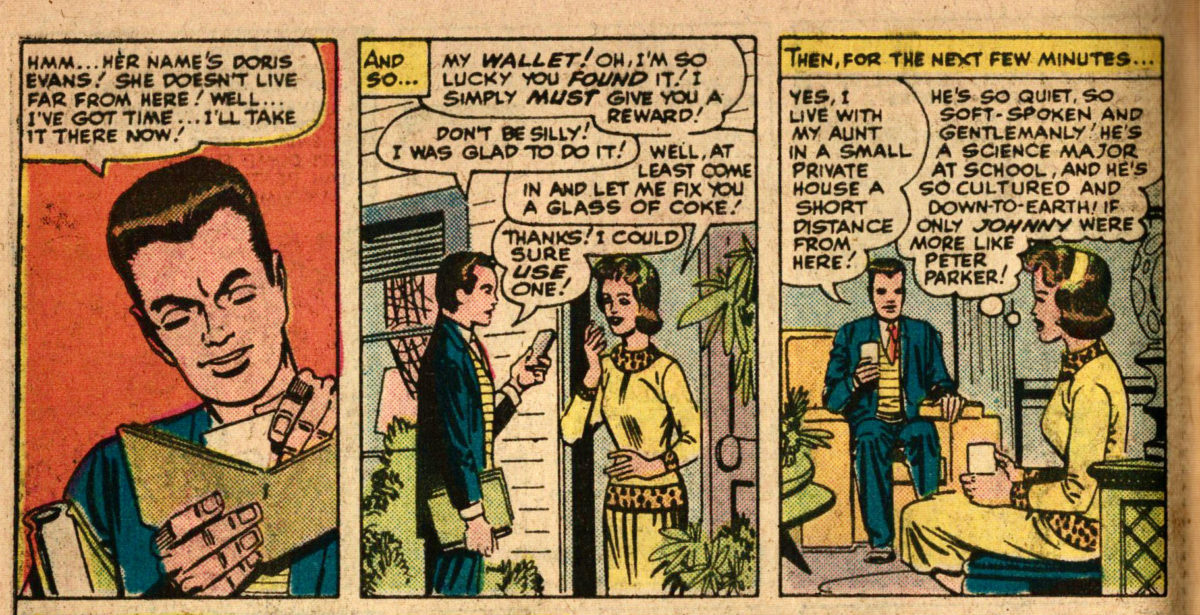
The first stories I ever read with Spider-Man were Transformers #3 and Avengers #317. In the Avengers saga, Spider-Man was offered membership in the Avengers, but when Spider-Man struggled to keep up on their space adventure, Captain America and Spider-Man both agreed membership wasn’t for him. Avengers was one of the first series I regularly followed, so I read Avengers #329 a year later, in which Spider-Man does officially join the Avengers. No explanation was given for why Cap and Spider-Man changed their mind. Avengers #329 is the first time he officially became an Avenger, but the arc in #314-317 was not the first time he came close. That is here.
The Avengers are an interesting grouping. They began as Thor, Hulk, Iron Man, Ant-Man, and the Wasp. All characters who had had solo (or duo) series. Left out of the Avengers were the Fantastic Four, already an established team, as well as Dr. Strange and Spider-Man. Behind the scenes, there seems a clear pattern that Kirby formed the Avengers from characters he had created, but left off the characters Ditko had created. They were soon joined by a revived old character of Kirby’s, Captain America.
When the original team disbanded, they needed replacements. Rather than turn to established loner superheroes like Daredevil, Dr. Strange, or Spider-Man, they sought out old enemies like Namor and Hulk, and accepted applications from reformed villains, Hawkeye, Quicksilver, and Scarlet Witch.
The Avengers know Spider-Man, or at least of him. He teamed up with Giant-Man and Wasp in Tales to Astonish #57; Wasp hated him because wasps and spiders are natural enemies. Spider-Man briefly ran into the individual Avengers in Amazing Spider-Man Annual 1. They fought a Spider-Man robot created by Kang in Avengers #11. And they were all guests at the wedding of Reed and Sue.
For his part, Spider-Man has mostly been a loner, but at the start of his career, he tried to join the Fantastic Four, only to learn they don’t pay a salary. You sometimes find yourself asking if things might have been different. What if Spider-Man had joined the Fantastic Four?
But the Avengers are funded by Tony Stark. Maybe they can afford to pay Spider-Man?
I think this is a really good comic, if we forgive some nonsense in the premise. Which we’ll get to.
It even has great art. Heck is the credited artist, and Romita is just credited with layouts, but a lot of Romita shines through, perhaps due in part to Esposito’s finishes. Layouts have been Heck’s biggest weakness as an artist.
Where does this fit in in Spider-Man’s story. The most important thing to note to me is that Peter Parker has the motorcycle he acquired in Amazing Spider-Man #41, so it’s after that. I think Amazing Spider-Man #41-43 read well as a story, united by arcs for the Rhino, Mary Jane, and John Jameson. So I didn’t care to break that up. Hence we are reading it after #43. This is where a lot of collections place it, including the Essential, Omnibus and Epic Collection. The Masterworks weirdly places it after issue 50. But I think the thinking there was just to put it at the end of one of their volumes and not worry about where it “goes”. The MCP wants it before issue 42, and the CMRO agrees, but that seems unnecessary when there are so many unresolved plot threads from issue 41 to deal with first.
“We’ve studied that photo of Spider-Man long enough” says Cap. How much was there to study in one photo? Detail-oriented heroes, I guess.
In the funniest line of any of these comics we’ve read, Hawkeye describes Spider-Man as “a real swinger”.
Captain America, famous for his tact, notes Hawkeye identifies with Spider-Man because they’ve both been outlaws.
The question before them is: Should Spider-Man be offered membership in the Avengers.
Featuring: Iron Man Release: October 11, 1966 Cover: January 1967 12 cents Story: Stan Lee Pencilling: Gene Colan Inking: Frankie Giacoia Lettering: Artie Simek 12 pages
From this moment on, Iron Man is more invincible than ever before!
In a plot greatly echoing a recent Daredevil story, Mandarin now believes Happy to be Iron Man, because Happy had been going around in the suit. In the Daredevil analog, Foggy had put on the Daredevil suit to impress Karen. Here, Happy was a bit more noble. He was trying to help preserve the secret identity, as the press was starting to suspect that Tony Stark was Iron Man. On the basis of the fact that it’s ridiculously obvious to anybody paying attention.
Flash Thompson has also gotten himself into similar trouble by wearing the Spider-Man outfit.
Unfortunately, Tony is still recovering from his recent heart attack. It’s not clear he’s in any shape to help Happy after the Mandarin captures him. And even wearing the armor, Happy is no match for Mandarin. He just doesn’t have the practice with it.
Featuring: Hulk Release: June 30, 1966 Cover: October 1966 10 pages Script… Stan (The Man) Lee Art… Almost the whole blamed bullpen Lettering… Artie (Smarty) Simek Therapy… Honest Irving Forbush 10 pages
Can a green-skinned introvert, with anti-social tendencies, find happiness and fulfillment in a modern materialistic society?
I leave it to your eagle eyes to determine who drew what in this issue. Some artwork may or may not be due to Bill Everett, Jerry Grandenetti, Gene Colan, Jack Kirby, Dick Ayers, John Tartaglione, Mike Esposito, Sol Brodsky, or others.
Can a green-skinned introvert, with anti-social tendencies, find happiness and fulfillment in a modern materialistic society?
We’d seen a similar question posed at the beginning of Hulk’s current series in issue 60.
Can a man with green skin and a petulant personality find true happiness in today’s status-seeking society?
In this issue’s Namor story, we learned Hulk was in the city. And this story is conveniently titled “Rampage in the City”.
Hulk thinks saving Betty from Boomerang means people won’t hate him anymore. Good luck with that.
Hulk used to be an Avenger, so he goes to New York to ask them to help him find Betty.
Featuring: Iron Man Release: August 9, 1966 Cover: November 1966 12 cents Smilin’ Stan Lee, author Genial Gene Colan, artist Gleeful Gary Michaels, inker Affable Artie Simek, letterer Ineffable Irving Forbush, referee 12 pages
If only the day would come when force is no longer necessary– when men would reason together instead! But, until such a time, we should be thankful that power such as Iron Man’s exists– and can be used in behalf of freedom!
Titanium Man holds Pepper hostage. The battle continues in DC, delaying Stark’s testimony to Congress.
“…for the sake of freedom everywhere, I dare not lose…” claims Iron Man. That sounds a little overly melodramatic and self-important to me.
The Maddening Mystery of the Inconceivable Adaptoid!
Featuring: Captain America Release: July 7, 1966 Cover: October 1966 12 cents Stan Lee authored the script Jack Kirby pencilled the story Frank Giacoia inked the drawings Artie Simek lettered the panels Irving Forbush sharpened the pencils 10 pages
I consider it a rare privilege to serve the mighty Avengers, sir!
Bucky was Captain America’s partner in World War II, killed by Zemo, who was working for the Red Skull.
But he seems to be back somehow?
No, it’s just a photograph.
Jarvis is the butler to the Avengers. He’d previously worked for Tony Stark, but Stark has been loaning his mansion to the Avengers for some time, and has lent Jarvis with it.
We don’t yet know much about Jarvis. He was introduced to us in Tales of Suspense #59, but presumably had been serving the Avengers since early on. He probably had second thoughts about the job when Hawkeye tried to prove his merits to join the team by attacking their butler.
This issue is the most lines he’s had yet. He notes it’s a privilege to serve the Avengers.
He offers to draw a bath for Cap, but Captain America can shower by himself. He’s a big boy.
Featuring: Iron Man Release: July 7, 1966 Cover: October 1966 12 cents Script: Stan Lee Pencils: Gene Colan Inks: Frank Giacoia Lettering: Artie Simek Emergency first aid: Irving Forbush 12 pages
Featuring: Dr. Strange Release: August 9, 1966 Cover: November 1966 12 cents Gloriously edited by Stan Lee Graniloquently scripted by Roy Thomas Gorgeously drawn by Wild Bill Everett Grudgingly lettered by Artie Simek 10 pages
It is the Sacred Griffin– the beast appointed by the priests of the Babylonian god Marduk to stand eternal vigil over the mystic text! It has ever been written in the Words of Flame that he who defeats the fearsome sentinel… is the destined possessor of the book!
Dr. Strange gets the cover again. Seems like he and Nick Fury will be trading off who gets featured.
We’re skipping the Nick Fury half of this comic to finish off the Kaluu arc.
O’Neill had been the writer for the last few issues, but Thomas fills in for this one. His scripting is described as “graniloquent”. Looks like Stan will return to the title next issue.
As you can see from the list down the page, Thomas is all in on the invocations.
So far, the Kaluu story has been terrible. Will Thomas turn it around?
Four issues into the battle, and Dr. Strange and Kaluu still haven’t met. So if we get that far, it will be a step up.
We’d heard Ancient One whine for several issues now about how powerful Kaluu is. But now Kaluu seems to fear that he will lose if his foes get any time to plan.
Featuring: Nick Fury, Agent of SHIELD Release: July 7, 1966 Cover: October 1966 12 cents Edited by: Stan Lee Layouts by: Jack Kirby Script by: Denny O’Neil Art by: Ogden Whitney Lettering by: Artie Simek Ammunition by the Forbush Pyrotechnic Co. 12 pages
Hydra can never be killed! Althrough you have captured Hydra’s body, its head is still free… It shall last forever! It has resources you have not dreamed of… resources that will insure its ultimate triumph!
It’s rare that the scripter doesn’t get credited ahead of the artists. When Lee was scripting, his name always came first. Now that Lee is editing, the editor’s name comes first. But then he put Kirby’s layouts ahead of the scripting and art in the credits.
The credits claim this issue’s writer and artist are surprises.
At this point, we know Denny O’Neil. He’s been taking over the scripting duties on Dr. Strange. But the name Ogden Whitney is new to us.
Featuring: Dr. Strange Release: June 9, 1966 Cover: September 1966 12 cents Magical editing by Stan Lee Mystic script by Denny O’Neil Mysterious art by Bill Everett Makeshift lettering by Artie Simek 10 pages
“…he will be punished for whatever dark deeds he has committed! I, Dr. Strange, vow it!” “Enough! Your babbling is that of a callow schoolboy, Disciple!”
Finally, Dr. Strange is starting to get the cover slot sometimes.
You can see my own copy of the cover has seen better days.
For this issue, O’Neil copies the structure of X-Men #12. That structure didn’t work then and this won’t either.
In the X-Men story, Juggernaut is attacking the X-Men, but rather than prepare, Professor X insists the X-Men must first know his entire life story, instead of just telling them the relevant bits.
Same idea here. Kaluu has just attacked and stolen the Book of the Vishanti. The Ancient One will keep stressing how urgently they must stop him. But first he thinks he needs to tell Dr. Strange his entire life story.