Featuring: Captain America Release: September 8, 1966 Cover: January 1967 12 cents A Stan Lee Jack Kirby premium presentation Inimitable inking by: Frank Giacoia Laborious lettering by: Sam Rosen 10 pages
Indeed, eet shall be for zee last time, mon ami…! For none may strike Batroc in such a manner… wizout paying zee price!
“This must be the place,” thinks Cap, anticipating David Byrne.
In Tales of Suspense #76, Captain America defeated Batroc, but a SHIELD agent on assignment succumbed to poison and was hospitalized. We didn’t learn her name. She reminded Cap of a woman he’d known in World War II, a woman whose name we also didn’t learn.
Featuring: Nick Fury, Agent of SHIELD Release: August 9, 1966 Cover: November 1966 12 cents Script… Stan Lee Layouts… Jack Kirby Pencils… John Buscema Inks… Frank Giacoia Letterings… Sam Rosen Ear plugs… Irving Forbush 12 pages
‘Cut off a limb, and two more shall takes its place!’ We were right… Hydra still lives!
We read the second half of this issue already. Last issue really ended the AIM stuff, and this issue begins the return of Hydra arc, so I wanted that cutoff. But the Dr. Strange stories cut a bit differently, as this issue ends the Kaluu arc and next issue properly begins the Umar arc.
Kirby is on hand for the layouts, but the main art credit goes to John Buscema. We spoke of him at length with his return to Marvel in Tales to Astonish #85, published one week prior to this. And we’ll be seeing a lot more of him.
We begin with Nick in a strange contraption performing a dangerous test. So dangerous, he won’t let anyone else do it. It’s a prototype Overkill Horn. They are concerned an enemy has a real one.
Perhaps a Super-Overkill Horn. Adding the word Super in front of something already called the Overkill Horn seems like, well, overkill.
Featuring: X-Men Release: September 1, 1966 Cover: November 1966 12 cents Editing.. Stan Lee Script.. Roy Thomas Art… Werner Roth Inks.. Dick Ayers Lettering… Sam Rosen Mayan headdresses… Irving Forbush 20 pages
I hate to sound like a poor man’s Hawkeye, but I can’t seem to stop myself! Why should Jean prefer Scott over me?
Last issue, the gem-hunter El Tigre found a pendant which transformed him into the Mayan feathered-serpent god Kukulcán. He now has the power of the sun. Which sounds pretty powerful.
This seems to be basically what happened to Don Blake. He found a mystic artifact and now finds himself the avatar for a god.
Featuring: X-Men Release: August 2, 1966 Cover: October 1966 12 cents Edited by: Stan Lee Scripted by: Roy Thomas Illustrated by: Werner Roth Inked by: Dick Ayers Lettered by: Sam Rosen Imitated by: Brand Echh 20 pages
At some point, we are faced with the question, are all these heroes interchangeable, or are their distinctions amongst the titles, making some stories more suitable for one title than another.
There are hints here of what I think the X-Men are about. Moments.
Featuring: Fantastic Four Release: August 2, 1966 Cover: November, 1966 25 cents Conceived and created by: Stan Lee (scenarist) & Jack Kirby (illustrator) Inked and lettered by: Joe Sinnott (Delineator) & Sam Rosen (Calligrapher) Recited and ignited by: Irving Forbush (part-time non-entity) 19 pages
The Original Human Torch! Reborn– only to die again!
We began our Marvel reading with Fantastic Four #1, released in August 1961. But Marvel had 22 years of history predating that comic. What is the relationship between those older comics and the modern 1960s ones? We’ve seen some impacts.
What you need is confidence in yourself and your abilities, Captain! From now on, I’m going to be right behind you to help you thru the rough spots until you gain that confidence!
After his triumphant return in September 1953, we come to June 1954, when it was decided Human Torch stories still weren’t selling enough. We’d read his return in Young Men. About 6 months later, they tried bringing back Human Torch’s old series.
They started with Human Torch #36, as the last one from 1949 had been #35. Never mind that they had already given the numbering to Love Tales.
Human Torch #38 is the final issue again.
There are three Human Torch stories and a Namor story. In the first Torch story, a mad scientist is tricked by Reds into sucking all the air out of the world in order to make his crippled daughter queen of the new world. In the second, the Torch and Toro rescue a general and his daughter from Korea.
Let’s read the final story from the final Human Torch comic.
All the Human Torch stories in his self-titled comic’s return have been by Dick Ayers, who we know well from our Marvel Age reading, particularly for his work on Sgt. Fury.
Ayers’ signature appears. The GCD credits Hank Chapman with the script and Ernie Bache with inks.
All the stories in this issue are narrated by Toro, and presented as though he is telling us of a past Human Torch adventure.
The title of the story is “Flame On!”, which is plainly the Human Torch’s catchphrase now. Johnny Storm will steal that catchphrase, along with the name and visage of the Human Torch.
Carl Burgos is on hand for the cover and draws the figure of the Human Torch on the opening page, but Russ Heath does most of the art for the issue. Notice Heath gives the Torch eyes and a mouth. Roy Thomas speculates that Heath had drawn the Torch on the first page, but an editor, perhaps Stan Lee, wasn’t happy and covered it with a Burgos drawing.
You can definitely see the difference as Heath gives the Human Torch weird eyes and a creepy smile instead of the blank face.
Burgos will return for the next 3 appearances of Human Torch in the pages of Young Men.
The Academy then publicly reinstated Horton, and recognized his greatest achievement, the Human Torch!
The popularity of superheroes waned post World War II, and in 1949, Marvel was ready to give up on the genre completely. This final issue of Marvel Mystery Comics features the last Human Torch story, as well as a Captain America story.
The series will change its name to Marvel Tales and become a horror anthology.
Human Torch’s own series ended with Human Torch #35 two months earlier. In that story, Human Torch travels to Venus to deal with some interplanetary diplomacy. Given that we know his flame is powered by oxygen, it’s not clear how he made it all the way there.
In a few months, Sub-Mariner’s story will come to an end, and later that year Captain America would have his final adventure in Captain America’s Weird Tales before the book became a full horror anthology.
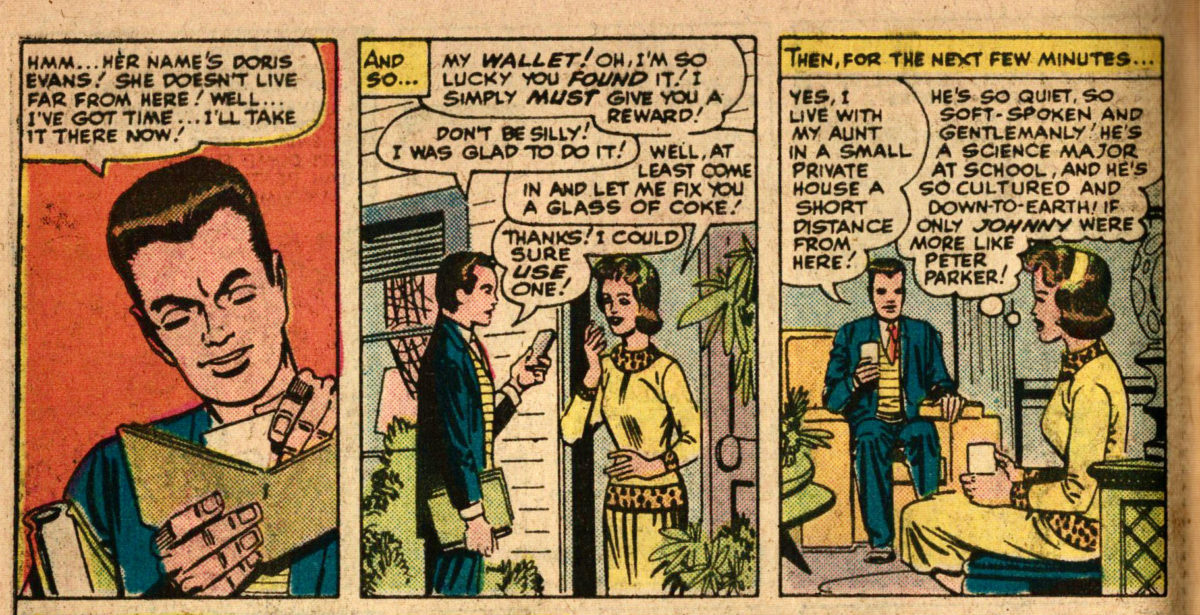
Human Torch was created by Professor Horton. He then turned on and killed his creator. Or did he? It was later revealed Horton was alive and working secretly for the US government. Any old conflict between Horton and the Torch seemed to be in the past. And the Torch later saved Horton’s niece Doris from foreign spies.
Now, we learn Professor Horton is dead. Again. We also learn I think for the first time his full name: Professor Albert Horton.
The Human Torch notes it’s been 10 years since he’s seen Horton. Either he’s rounding or something off. They were together in 1942, and certainly those stories take place after the US joined the war.
But this issue seems to not acknowledge those 1942 stories and wants to claim Human Torch hasn’t seen Horton since his first adventure in 1939.
We get a retelling of the Torch’s origin. Apparently thousand of readers have asked to hear the origin of the Human Torch. Why not just track down Marvel Comics #1?
And did these readers want to read the origin of the Human Torch only to then never read another Human Torch story again? Because that’s what they’re getting.
Dictators! We’ve had enough of them! Atomic power must be used for peace, not war! It must be used to make life better for all people! The coming Atomic Age is not for one man– it is for the common man– for all mankind!
No credits are given. The GCD credits the writing to Batman/Green Lantern co-creator Bill Finger and some of the pencilling to Syd Shores. The Bill Finger credit comes from the writer’s own recollections in the 1960s, related to historian and “father of comic book fandom” Jerry Bails.
I’d been debating when to read this. We’ve done some overview read-throughs of Captain America and Sub-Mariner, and are in the middle of one for the Human Torch. The other main characters to appear in this issue are Miss America and the Whizzer, whom we haven’t met yet. And I don’t have a good reason to introduce them anytime soon. The best excuse will probably be their return in Giant-Size Avengers #1 from 1974, but this blog won’t be getting there anytime soon at the rate I’m going.
This would also pair well with the introduction of the Invaders, but that’s not until 1975.
So let’s read this now along with our Human Torch read-through. It’s an important comic in Marvel history. We’ll just try to figure out who Miss America and the Whizzer are as we go. Something something mongoose something.
Roy Thomas described this comic as “a great idea whose time had gone.”
You two big lugs oughta be ashamed of yourselves! Spies are all around, threatening our country! The Python is on the loose! Democracy is in danger– and you fight each other instead of fighting the common enemy!
No credits are given. The GCD discusses the research into who is behind this based on later interviews, recollections, art analysis, etc. They credit the writing to Mickey Spillane and Ray Gill. They credit the art to Allen Simon, Harry Sahle, Al Gabriele, and possibly Eddie Robinson, Carl Pfeufer, and others.
Mickey Spillane is best known for his graphicless novels featuring Mike Hammer.
Notably, Torch creator Carl Burgos, who told the first few years of Torch stories is not involved, because he’s off fighting in World War II.