Featuring: Captain America Release: September 8, 1966 Cover: January 1967 12 cents A Stan Lee Jack Kirby premium presentation Inimitable inking by: Frank Giacoia Laborious lettering by: Sam Rosen 10 pages
Indeed, eet shall be for zee last time, mon ami…! For none may strike Batroc in such a manner… wizout paying zee price!
“This must be the place,” thinks Cap, anticipating David Byrne.
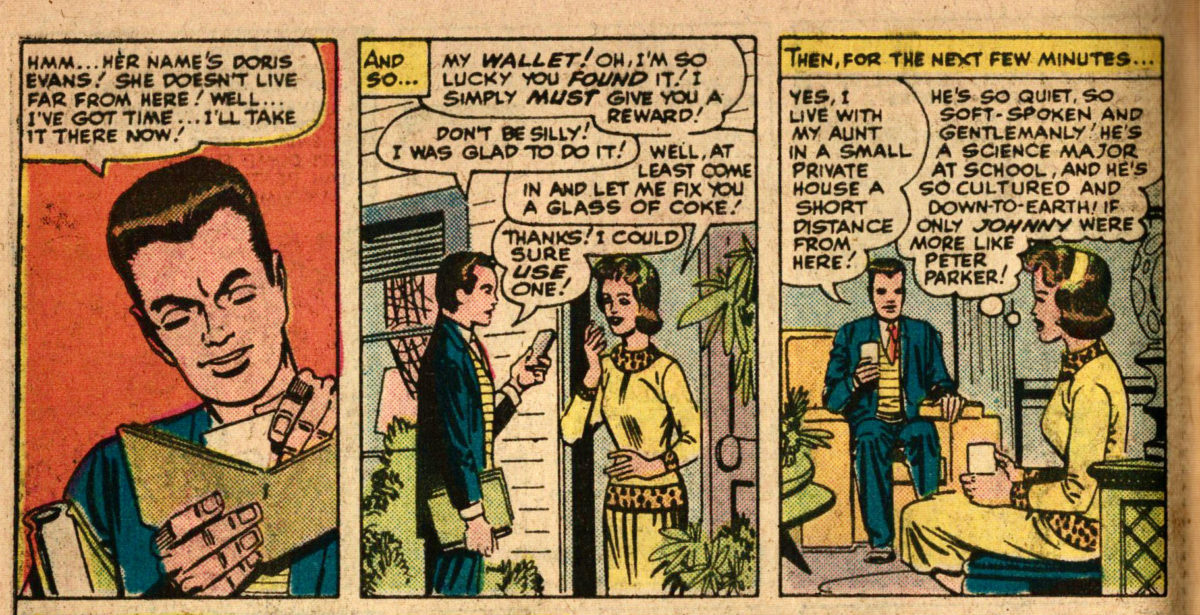
In Tales of Suspense #76, Captain America defeated Batroc, but a SHIELD agent on assignment succumbed to poison and was hospitalized. We didn’t learn her name. She reminded Cap of a woman he’d known in World War II, a woman whose name we also didn’t learn.
Featuring: Nick Fury, Agent of SHIELD Release: August 9, 1966 Cover: November 1966 12 cents Script… Stan Lee Layouts… Jack Kirby Pencils… John Buscema Inks… Frank Giacoia Letterings… Sam Rosen Ear plugs… Irving Forbush 12 pages
‘Cut off a limb, and two more shall takes its place!’ We were right… Hydra still lives!
We read the second half of this issue already. Last issue really ended the AIM stuff, and this issue begins the return of Hydra arc, so I wanted that cutoff. But the Dr. Strange stories cut a bit differently, as this issue ends the Kaluu arc and next issue properly begins the Umar arc.
Kirby is on hand for the layouts, but the main art credit goes to John Buscema. We spoke of him at length with his return to Marvel in Tales to Astonish #85, published one week prior to this. And we’ll be seeing a lot more of him.
We begin with Nick in a strange contraption performing a dangerous test. So dangerous, he won’t let anyone else do it. It’s a prototype Overkill Horn. They are concerned an enemy has a real one.
Perhaps a Super-Overkill Horn. Adding the word Super in front of something already called the Overkill Horn seems like, well, overkill.
Featuring: Fantastic Four Release: August 2, 1966 Cover: November, 1966 25 cents Conceived and created by: Stan Lee (scenarist) & Jack Kirby (illustrator) Inked and lettered by: Joe Sinnott (Delineator) & Sam Rosen (Calligrapher) Recited and ignited by: Irving Forbush (part-time non-entity) 19 pages
The Original Human Torch! Reborn– only to die again!
We began our Marvel reading with Fantastic Four #1, released in August 1961. But Marvel had 22 years of history predating that comic. What is the relationship between those older comics and the modern 1960s ones? We’ve seen some impacts.
Featuring: Fantastic Four Release: July 7, 1966 Cover: November 1966 12 cents Produced by: Stan Lee and Jack Kirby Delineated by: Joe Sinnot Lettered by: Artie Simek 20 pages
Our biggest problem seems to be keeping the somewhat disoriented Marvel Universe in some semblance of order! But, when you constantly mess around with space/time warps, and continuums, negatives zones, intra-cosmic deviationary fields, and universes beyond the reached of infinity, you’re apt to get a little bit confused! So bear with us, erudite one, for verily thou hast the seeming of a true believer!
Two notes about the credits. The first is that there are two Ts in Sinnott.
The second is that the credits will stop specifying Stan Lee as the writer, when Kirby is doing most of the writing. The compromise is the nebulous “produced by” credit. Ditko had fought for a similar credit in his comics before leaving.
Sue is upset that Reed is always working, and not spending enough time with his wife. Not the first time we’ve seen this complaint.
Reed has all kinds of fancy technology, including a visi-phone which connects to his lab. Wow. A visi-phone. Imagine being able to talk to someone remotely and see them at the same time!
Featuring: Fantastic Four Release: July 7, 1966 Cover: October 1966 12 cents Scripted with a smile by: Stan (The Man) Lee Pencilled with a passion by: Jack (King) Kirby Delineated with a dignity by: Jovial Joe Sinnott Lettered with a lilt by: Swingin’ Sammy Rosen Applauded with Aplomb by: Honest Irving Forbush 20 pages
I have seen men build… and destroy! I have seen this world, which could be paradise, reduced to a planet of greed, and fear, and hatred! I have seen humanity with its heritage betrayed!
When Galactus came to devour Earth, Silver Surfer was his herald. But Silver Surfer met Alicia Masters, and she convinced him that humanity was worth saving. So Silver Surfer betrayed his master. As punishment, Galactus took Silver Surfer’s space-time powers from him. This presumably means he cannot fly faster than light speed, so is practically confined to within a lightyear or so of Earth.
Thing hadn’t been happy that Alicia seemed so impressed by the Silver Surfer, and spent some time moping in the rain about it.
Johnny and Wyatt have been on their way to the Great Refuge of the Inhumans since they left Wakanda. Along the way, they came across Prester John and the Evil Eye, which Johnny thought might break the Negative Zone barrier around the Great Refuge. But that didn’t work out.
Shouldn’t Johnny and Wyatt be in school?
Reed still owes Sue a proper honeymoon. Though he has taken her to the Great Refuge and Wakanda. But I guess she wants somewhere just the two of them where they don’t battle evil. Women, eh.
Featuring: Hulk Release: November 3, 1966 Cover: February 1967 12 cents Hulkamorous script by: Stan (The Man) Lee Hulkitudinous art by: Gil (Sugar) Kane Hulkifying lettering by: Sammy (Dozin’) Rosen 10 pages
The poor, lumbering brute! He was guilty only of being feared– and misunderstood!
Gil Kane is going to become a big name at Marvel. We’ve seen him once before on a Hulk story a dozen issues back under the alias of Scott Edward and we reviewed his career at the time.
It’s possible this is his first properly credited Marvel work.
He brings a distinctive style, a very different take on Hulk from that of John Buscema the past two issues.
It’s been 7 issues since Boomerang entered Hulk’s life. We finally see that saga reach a conclusion. It’s been a long road, and I summarize in painstaking detail that road below. These past 6 months have been the most interconnected the Marvel Universe has yet been. Perhaps fittingly we will soon see that the phrase “Marvel Universe” also debuted in that timespan.
At this point it seems like everybody knows Hulk’s secret identity. But the first person to learn it after Rick was the President of the United States, presumably President Johnson. And that is presumably President Johnson now interceding on Hulk’s behalf.
Unfortunately, Boomerang intervenes and drives Hulk to a rampage and another conflict with the military.
Featuring: Hulk Release: October 11, 1966 Cover: January 1967 12 cents Story: Smilin’ Stan Lee Art: Big John Buscema Inks: Mighty Mickey D. Lettering: Adorable Artie S. 10 pages
“Have you gone mad?” “I hope so! It’s what I’m counting on!”
Every issue has a nickname for these creators. I claim the most enduring for Lee is Stan (The Man) Lee. Though I might guess that in our reading so far, Smilin’ Stan Lee is the most common nickname.
This is only John Buscema’s second month in his return to Marvel, and Stan has already found the nickname that will stick. Big John Buscema is the one I most associate with him.
Adorable Artie is also one of the more common ones. Stan loves his alliteration.
We left Hulk in Manhattan battling the Leader’s Hulk-Killer Humanoid. The Secret Empire is defeated. Boomerang is still up to stuff.
Featuring: Prince Namor the Sub-Mariner Release: October 11, 1966 Cover: January 1967 12 cents Story: Stan (The Man) Lee Illustration: Wild Bill Everett Lettering: Adorable Artie Simek 12 pages
Rise, my lady! Let your head be lifted– avert not your eyes! From this moment forth–by imperial decree– the Lady Dorma may never again kneel in the presence of her liege! She stall stand at my side–with all due honor– as one who shall someday be princess of the realm! –As one who is truly a peer! And, know you, my lady– whatever befalls– the gratitude– the trust– and the heart of your prince shall be yours– while Atlantis endures!
Big day for Bill Everett, creator of the Sub-Mariner. He had half-returned to his creation, supplying finishes to other artists’ pencils. But starting this issue, he becomes the regular artist on the character who in any world with sensible laws would have belonged to him all along.
We’ve been following not quite a story, but let’s call it a sequence of events that has propelled us from issue 77 to here. Across 11 issues, Namor has had a lot of misadventures unified by the scheming of Krang, and his kidnapping of Dorma, which Namor mistook for Dorma’s betrayal. It finally comes to and end, and we can put Namor’s arc down for a while.
Krang and Dorma have been captured by the military. Krang’s serum has worn off, revealing their blue skin, and leaving them unable to breathe on land. Namor comes to them, but the military has a trap for him. Because they blame Namor for Krang’s flooding of Manhattan.
Though I’ve lived as the monstrous Hulk– I’ll die as Bruce Banner– I’ll die as– a man!
John Buscema still on art.
The Secret Empire stands defeated, but their agent Boomerang remains at large. The Orion Missile is heading for New York. Hulk leaped at the missile, and somehow this calmed him down. So now Bruce Banner is riding a missile.
The transformation here is really badly storyboarded; just Bruce one panel and Hulk the next. Stan compensates with narration to make up for the artistic failings. Come on, Big John!
Featuring: Prince Namor, the Sub-Mariner Release: September 1, 1966 Cover: December 1966 12 cents Story by Smilin’ Stan Lee Pencilling by Merry Jerry Grandenetti Inking by Wild Bill Everett Lettering by Adorable Artie Simek 12 pages
But, not even a prince of the blood can possess patience without limit!
Grandenetti is a new name to us, and really to me as well. This is one of very few Marvel works; we’ll see him again on Sgt. Fury in the near future. He got his start assisting and ghosting for Will Eisner on The Spirit and has been working comics at DC since the early 1950s, focused on war comics, and has lately started to do some side work for Warren, Charlton, Tower, and apparently Marvel at least once, sometimes ghosting for Joe Orlando. Here’s a sampling of his art.