Soon, my limbs shall be swifter than ever before– while your hex power once again shall dazzle and defeat your enemies! All we need is patience, my sister– and an unaltering faith!
The Avengers are off to South America to save Goliath. And presumably will be here when Galactus attacks.
Hawkeye now likes Captain America, but still dislikes orders. As do I, Hawkeye. As do I.
Wasp recalls how they all used to share the command. It’s the first time they’ve really addressed this change. The original team had rotating chairs. The new team had Captain America as permanent leader. Given this, Hawkeye’s annoyance was understandable.
Featuring: Spider-Man Release: April 12, 1966 Cover: July 1966 12 cents Written and edited by Stan Lee Plotted and drawn by Steve Ditko Lettered, unfettered by Artie Simek 20 pages
We come at last to the final Steve Ditko Spider-Man story. We just saw the final Steve Ditko Dr. Strange story. One thing they have in common is awful covers. My best guess is Ditko had resigned before turning in a cover for either. So like the Dr. Strange cover, this cover is cut and paste from Ditko’s artwork within the issue.
Here are the interior panels the cover cribs from:
I’ve been pretty clear that the saga of the Amazing Spider-Man as told by Stan Lee and Steve Ditko is basically my favorite story ever. I won’t belabor why any further than I have in the posts on the last 37 issues.
I’d also been pretty clear that I thought that story ended extremely well with issue 33. And that these last 5 issues represent a step down in quality, and a story that no longer seems to be going anywhere in particular.
I find it unfortunate that that was not Ditko’s final issue of Spider-Man. As the man says, it’s better to burn out than to fade away. I wish he’d gone out at the top of his game.
That excellent climax of the Spider-Man saga came out the same month as the excellent climax of the Dr. Strange saga in Strange Tales #141. Both series then went at the same time into a phase I’ve described as “spinning their wheels”. Where any of the next 4 months of issues could have been removed with minimal consequence. Ditko had one more great Dr. Strange story in him, a final confrontation between Dormammu and Eternity.
Does he have one more great Spider-Man story in him?
It’s worth nothing that the last several issues have not been bad and they have their charms. Despite the small number, this phase can actually be broken into two subphases. Issues 34-35 pit Spider-Man against returning foes, Kraven and Molten Man respectively. Some minimal advancement to the romantic supblots surrounded by action that is well told, but not adding much to Spider-Man’s previous encounters with these villains.
Issues 36-38 take a different tactic. They all introduce new villains, none of whom will become the iconic villains that the rest of the series had introduced. But all are interesting in their own right, and all have stories that center around them. Spider-Man becomes almost a secondary character, as we get to know the Looter and the Robot Master.
And they’re actually good comics, taken on their own terms, and not compared to the expectation of Spider-Man comics we’d developed over the previous 4 years of stories. Just offbeat tales about some offbeat characters who run into Spider-Man, tales that function more as satire than drama.
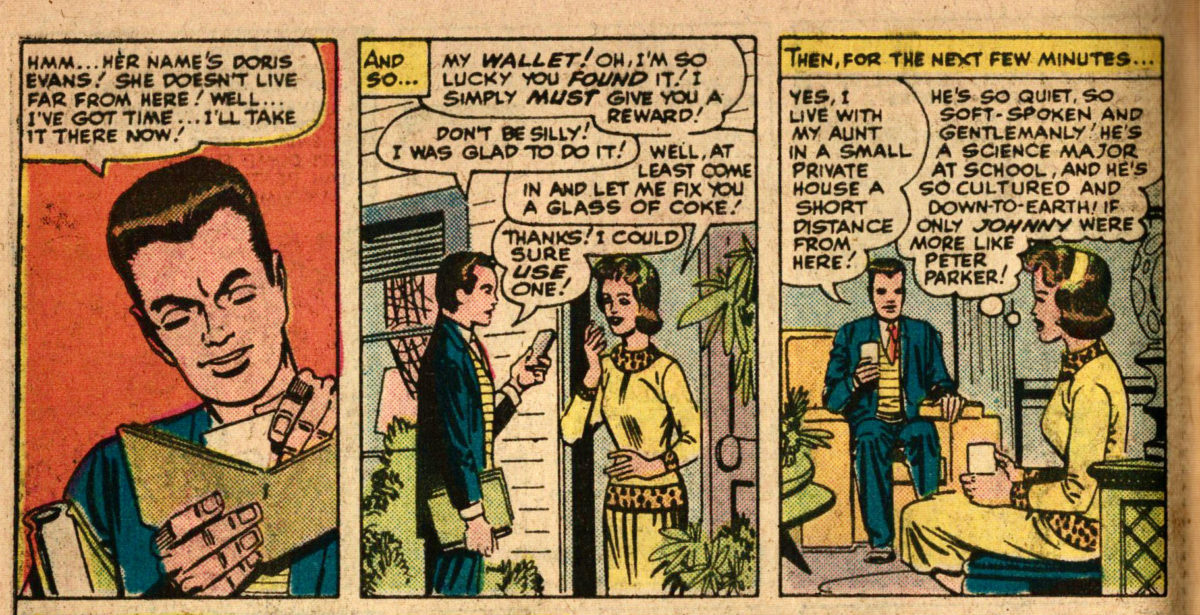
This falls into that mold. The story, Ditko’s final Spider-Man story, isn’t really about Spider-Man. It’s about this guy named Joe.
Featuring: Dr. Strange Release: April 12, 1966 Cover: July 1966 12 cents Edited by the enchanter– Stan Lee Penciled + inked by the prestidigitator– Steve Ditko Scripted by the sorcerer– Dennis O’Neil Lettered by the letterer– Artie Simek 10 pages
We recently described Fantastic Four #50 as the most disappointing cover yet. This may top it. Again, just compare the cover of the issue to the first page of the issue and see the contrast.
This is sad because it’s Ditko’s last Dr. Strange story, and because Dr. Strange has been snubbed from the covers of Strange Tales for the entire run. Even more insulting because the spotlight was instead given to the inferior Human Torch stories. The one time Dr. Strange was finally given the cover spotlight, Kirby, not Ditko, was assigned to draw it.
So here we are, Ditko’s final issue of one of the greatest superhero runs in history and finally we seemingly get our very first Ditko Dr. Strange cover. Except it’s a lie.
That is a Ditko Dr. Strange but it’s been badly cut and pasted from interior art. Resized, flipped around, generally mangled. The Eternity image is also cut and paste from the interior.
I don’t believe Ditko actually made this cover, though it’s generally credited to him. I think someone else made the cover, assembling bits of interior art by Ditko.
I hate it.
The issue is good. This first page is closer to what the cover should look like.
I’d given a lot of hype to this extended saga, which I’m calling “The Eternity Saga”. And I think the first 12 issues are unimpeachable. From #130-141, the action flows crisply to a climax, ending with the final defeat of Mordo and Dr. Strange and Dormammu in something of a stalemate after Strange’s humbling of Dormammu. The story then completely lost momentum as Dr. Strange dealt with Mordo’s underlings and searched for the woman who had helped him, facing some unrelated threats along the way. The last 4 issues have been solid comics, but don’t help make the case that we have a great 17-part saga. We have a great 12-part saga, then 4 more issues, then this conclusion.
Let’s see how Ditko brings this home. And this will be bringing it home. With this story, Ditko bids goodbye to Marvel for the foreseeable future and to the character of Dr. Strange forever.
Stan seems utterly indifferent to the importance of the moment. In addition to the sloppy cover, Stan has junior writer Dennis O’Neil onboard for his second Dr. Strange story and one of his earliest comics, period. It doesn’t matter too much who the writer is, as Ditko does most of the writing anyway. O’Neil will stay on the title a few more issues, but soon enough move to DC, where he will go on to great things.
Featuring: Fantastic Four Release: March 10, 1966 Cover: June 1966 12 cents Writer: Stan Lee Penciller: Jack Kirby Inker: Joe Sinnott Letterer: Artie Simek 20 pages
He paid the full price– and, he paid it– like a man!
After introducing the Inhumans, and then introducing the Silver Surfer and Galactus in perhaps the best and most iconic FF story ever immediately after, you’d think Stan and Jack would want a break from the iconic stories that will be remembered for decades to come.
But this is perhaps the most iconic issue of Fantastic Four ever. It’s perhaps the best Fantastic Four comic ever. It might be the best comic Stan and Jack ever made.
It might be the best comic anybody ever made.
The World’s Greatest Comic Magazine indeed.
I won’t ruin this image with my clumsy words. You can just appreciate the opening page for yourself. I just suggest that you take a minute with it.
This picks up from last issue in a couple ways. Alicia and the Silver Surfer grew close during the events, enough to make Thing jealous and wander off morosely. There were even newspaper headlines about Thing being seen wandering the streets feeling sad. We saw a mysterious man reading those headlines. We didn’t learn his name, but we learned he intends to destroy the Fantastic Four.
Featuring: Fantastic Four Release: December 12, 1965 Cover: March 1966 12 cents Stan Lee, writer without peer! Jack Kirby, penciller of the year! Joe Sinnott, inker most sincere! Artie Simek, how’d he get in here! 20 pages
My journey is ended! This planet shall sustain me until it has been drained of all elemental life! So speaks Galactus!
There’s a lot going on in this issue, and a lot to say. So we’ll break it into sections.
The end of the Inhumans saga
We were reading the Inhumans saga in Fantastic Four #44–47. And it wasn’t done. Maximus, the mad would-be king of the Inhumans, was just about to wipe out all humanity with his weapon.
Despite this cliffhanger, we left the saga behind to check in on the rest of the Marvel Universe. We’ve read 70 other stories over the 9 months since we left ourselves hanging. The story concludes this issue. Prior to issue 44, the longest FF saga was 3 parts in the previous 3 issues, #41–43, clocking in at 60 pages. Before that, the longest FF saga was the 2-part #39–40, clocking in at 40 pages.
We’ve already ready 4 issues and 80 pages of the Inhumans arc, and we’re not done! Here we are on the 5th issue. Since this issue is another 20 pages, does that mean it’s a 100-page long saga?
I would say no. I would put it at about 86.7 pages.
That’s right. There are less than 7 pages left.
The Fantastic Four have found the Great Refuge within the Andes. Black Bolt wants them to leave immediately. Reed wants Black Bolt to stop hiding from humanity. Crystal and Johnny want each other.
And Maximus… he fires his “atmo-gun”, which will send vibrations that only affect humans into the air, leaving the Inhumans the rulers of the world.
Featuring: Captain America Release: March 10, 1966 Cover: June 1966 12 cents Wondrous words by: Stan Lee Awesome art by: Jack Kirby Incredible inking by: Frank Giacoia Lop-sided lettering by: Artie Simek 10 pages
…the world will soon tremble before the power of– Them!
In Captain America’s recent battle with Batroc, Batroc was working for some secret cabal. In the pages of Strange Tales, we learned the Fixer was working for some secret cabal called Them. They had some plot involving miniature brains. I don’t know if these two cabals are connected.
Nick Fury confronts Captain America at Avengers HQ. This is their first meeting in the present. Captain America refers to him as “Sarge”, but it’s Colonel Fury now. They reference fighting together, presumably referring to Sgt. Fury #13. That is the only prior meeting we know of.
When Fury notes Cap hasn’t aged much, Cap says Fury seems pretty well-preserved himself. Is this just a compliment? Or a first hint that Fury uses some form of special formula to keep himself young. They last met 20 years ago. Fury could have been in his ’20s then and ’40s now.
Featuring: Iron Man Release: March 10, 1966 Cover: June 1966 12 cents Spectacular story by Stan Lee Pace-setting pencilling by Gene Colan Indescribable inking by Gary Michaels Lonesome lettering by Artie Simek 12 pages
Ultimo, who never really lived– is now truly dead!
Stark factories are closed because Senator Byrd has cancelled the Defense contracts. Tony Stark is missing because Iron Man is in Asia battling Ultimo, the android creation of the Mandarin.
We get a cool time lapse splash page. Ditko often did these time lapse panels in his Spider-Man stories.
Of course, the flip side of all these splash pages and large panels is we get fewer panels to tell the story.
Featuring: Dr. Strange Release: March 10, 1966 Cover: June 1966 12 cents Eerily edited by: Stan Lee Spookily scripted by: Dennis O’Neil Demonically drawn by: Steve Ditko Laconically lettered by: Artie Simek 10 pages
Am I a child, to be frightened by a mere illusion– a shadow of shadows?
Lee seems to have stepped away as the regular writer for the end of Ditko’s run. Just as well as Ditko has been doing most of the writing and refusing to even speak to Lee for a little while anyway.
Roy Thomas stepped in the last two issues, and now we have Dennis O’Neil. While for artists, Stan has been seeking veterans from the ’40s and ’50s, for writers, he has been giving new talent a try. Thomas is new to comics, and O’Neil was hired at his suggestion. This is O’Neil’s first comic work. He’ll go on to do some good things, and will perhaps be eventually better known for his work with the Distinguished Competition.
That Lee is handing off scripting duties to new and untested writers gives a hint as to how important these Dr. Strange stories are to him.
We meet a villain named Mr. Rasputin. He uses magical and scientific means to do espionage. His ancestor had been a famous Russian advisor.
Featuring: Dr. Strange Release: February 10, 1966 Cover: May 1966 12 cents Edited with percipacity by: Stan Lee Written with precocity by: Roy Thomas Plotted and illustrated with profundity by: Steve Ditko Lettered with the windows closed by: Artie Simek 10 pages
How dare you make a request of the great Tazza! In the name of Satannish the Supreme, you shall join the other unmoving forms in my hallowed halls…
We are in what I see as the spinning-the-wheels phase. We had an extremely tense and fast-paced adventure that took us from issues 130-141. Then it slowed down. Mordo was defeated. Dormammu was humbled. Loose plot threads included servants of Mordo’s to deal with, and this woman who had helped Strange, who was now a prisoner of Dormammu. We’ve spent the last couple issues dealing with Mordo’s servants and now we’ll go look for this unnamed woman.
Dormammu was beaten with yet another vow to not move against Strange. But there’s a loophole if you read the fine print. Dormammu agreed not to attack Strange on Earth. But if the good Doctor travels to another dimension…
Let’s talk about your costume! Those red longjohns break me up– but I liked your old yellow duds better! … I mean they matched your new yellow streak!
This might be the first time we learn the true identity of Frankie Ray, really Frank Giacoia. For a lot of these people, the aliases are about not sabotaging regular gigs with Marvel’s competition. Frank Giacoia was a regular DC artist at the time, and hadn’t necessarily wanted them knowing he was freelancing for Marvel. But at some point it becomes clear, or his Marvel gig becomes the more regular gig, and it just stops mattering. Though by this point Marvel fans might know him best as Frank or Frankie Ray and not recognize the name Frank Giacoia.
Just like they might be confused if a comic were credited to Stanley Lieber or Jacob Kurtzberg.
That’s a great cover by Romita and Giacoia. The cityscape is detailed but the lack of color keeps it subtly in the background, leaving the focus on the two colorful characters. This is our first chance to see Spider-Man as rendered by John Romita. He captures that sense of agility that Ditko creates, and you can feel the motion of the cover, even without the helpful motion lines.
We’ve talked a bit about the tension in the pages of Amazing Spider-Man. Lee and Ditko aren’t getting along and Ditko is looking out the door. Lee is well aware of this, but has a huge problem. Spider-Man is his best comic, indelibly associated with Steve Ditko. You can’t just throw anybody on the book. Jack Kirby is Stan’s go-to artist when he needs a good one, but Jack had drawn Spider-Man a couple times by this point, and it was never right. And Jack’s style– while perfect for Fantastic Four– just wasn’t Spider-Man. Nobody was Steve Ditko.
We talked in the last issue about John Romita, who recently passed away. He’s been on Daredevil since Wally Wood left, following a succession of legendary talent from Bill Everett to Joe Orlando. And Romita has been more than up to the task of making his own mark on Daredevil.
But John Romita is not famous for drawing Daredevil. And while he excelled at the romance comics he had been drawing, that’s not really what made him a household name amongst fans. His step into legendary status will come with his next assignment, and this issue will serve as his audition for that assignment.
So, how well can John Romita draw Spider-Man? Let’s find out.