Featuring: Avengers Release: October 11, 1966 Cover: December 1966 12 cents Edited (ecstatically) by Stan Lee Scripted (surprisingly) by Roy Thomas Drawn (dynamically) by Don Heck Lettered (legibly) by Sam Rosen 20 pages
To be an Avenger is to surrender a part of one’s life… to be ever at the beck and call of humanity! Still, in these quiet moments, each of the others has another human being to whom he can reach out… only I have no one… no life, except behind the mask of the Red-White-and-Blue Avenger!
This begins a 70-issue run on Avengers by Roy Thomas. Thomas will have his highs and lows over those 70 issues, and it will take him a minute to warm up and get into the groove, but on the whole I think his Avengers will be much better than Stan Lee’s.
We’ll try to note along the way milestones marking an increase in quality. I’ll offer a hint that a new artist is going to help a lot.
The slow move of Stan off scripting duties, and the expanding bullpen of artists… this is a transition into the next era of Marvel Comics. Where it’s not Stan and Jack and Steve making most of the comics.
Featuring: Avengers Release: September 8, 1966 Cover: November 1966 12 cents Spellbinding story: Smilin’ Stan Lee Awe-inspiring artwork: Dashin’ Donnie Heck Lots of little lettering: Adorable Artie Simek 20 pages
This is Stan Lee’s final credited issue of The Avengers. He may have had a hand in next issue. But starting next issue, the official scripting duties will be passed to Roy Thomas.
He leaves without much fanfare. Especially for a man so known for talking to his audience. No goodbye, no notes about it. He wrote 34 issues of one of the most beloved superhero teams of all time, and then just handed off the duties.
And he doesn’t try to go out with a bang, not really. It’s the first part of a two-part story. I wonder if he does that intentionally, thinking it’s easier for a new writer to finish off a story than come up with a new one. His final Spider-Man (comic book) story will have a similar flavor, introducing a new villain and then leaving the second part to the incoming writer.
Last issue’s blurb about this issue, went “Next: Goliath changes!”
I took that to mean he was going to finally change his clothes and wash this outfit. The blurb in the letters page hinted at more, that this would relate to Goliath’s efforts to return to normal size. It also hinted we’d see the return of Bill Foster, and of Wanda and Pietro.
We do get the return of Bill Foster, not seen since, well, last issue. But nothing else along those lines happens in this issue, and we get an editor’s note apologizing and assuring us that a big change is coming for Goliath. I think the pun is intended.
…To Become an Avenger! Featuring: Spider-Man Release: August 2, 1966 Cover: November 1966 25 cents Smilin’ Stan Lee Layouts by Jazzy Johnny Romita Pencilin’ by Dashin’ Donnie Heck Inking’ by Mirthful Mickey Demeo Letterin’ by Adorable Artie Simek 21 pages
I can’t fight it any longer! I’ve got to follow my own destiny– and let the chips fall where they may! I must have been given my spider-power for a reason! Thor was right! I do have an obligation– to mankind!
This is a “King-Size Special”. Which Marvel will sometimes be calling their Annual issues.
It boasts “72 Big Pages”. Let’s do math. The story is actually a pretty normal-sized 21 pages, but they reprint two old Spider-Man stories (issues 11 and 12), which brings the total to 64 pages. What are the other 8 pages? A table of contents, and some ads. When they advertise 72 pages, they are advertising 7 pages of ads.
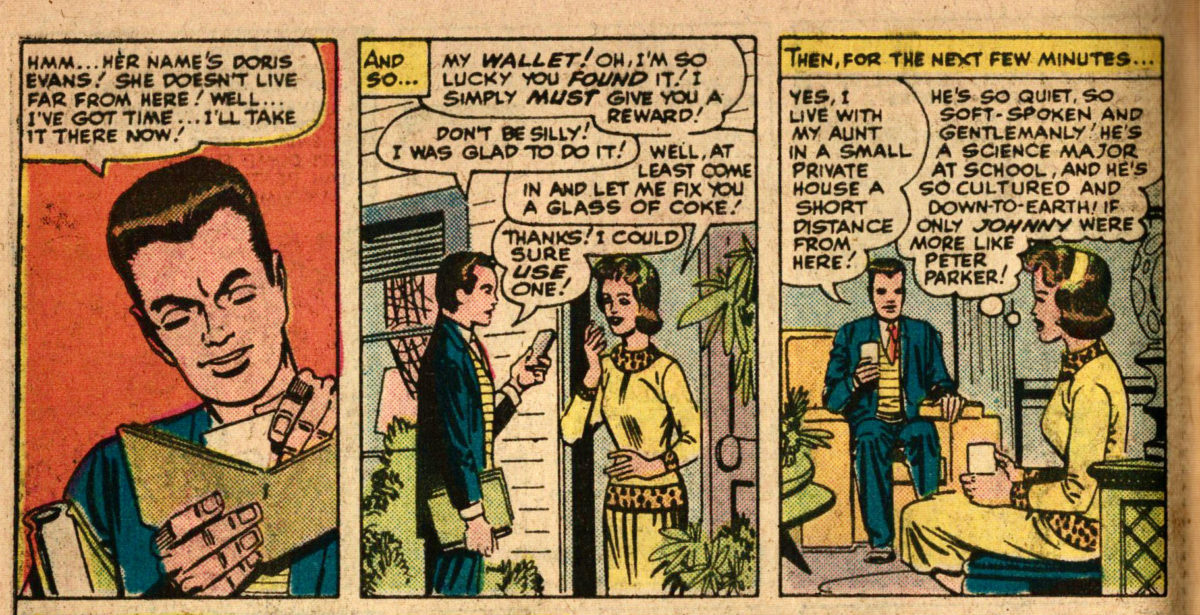
The first stories I ever read with Spider-Man were Transformers #3 and Avengers #317. In the Avengers saga, Spider-Man was offered membership in the Avengers, but when Spider-Man struggled to keep up on their space adventure, Captain America and Spider-Man both agreed membership wasn’t for him. Avengers was one of the first series I regularly followed, so I read Avengers #329 a year later, in which Spider-Man does officially join the Avengers. No explanation was given for why Cap and Spider-Man changed their mind. Avengers #329 is the first time he officially became an Avenger, but the arc in #314-317 was not the first time he came close. That is here.
The Avengers are an interesting grouping. They began as Thor, Hulk, Iron Man, Ant-Man, and the Wasp. All characters who had had solo (or duo) series. Left out of the Avengers were the Fantastic Four, already an established team, as well as Dr. Strange and Spider-Man. Behind the scenes, there seems a clear pattern that Kirby formed the Avengers from characters he had created, but left off the characters Ditko had created. They were soon joined by a revived old character of Kirby’s, Captain America.
When the original team disbanded, they needed replacements. Rather than turn to established loner superheroes like Daredevil, Dr. Strange, or Spider-Man, they sought out old enemies like Namor and Hulk, and accepted applications from reformed villains, Hawkeye, Quicksilver, and Scarlet Witch.
The Avengers know Spider-Man, or at least of him. He teamed up with Giant-Man and Wasp in Tales to Astonish #57; Wasp hated him because wasps and spiders are natural enemies. Spider-Man briefly ran into the individual Avengers in Amazing Spider-Man Annual 1. They fought a Spider-Man robot created by Kang in Avengers #11. And they were all guests at the wedding of Reed and Sue.
For his part, Spider-Man has mostly been a loner, but at the start of his career, he tried to join the Fantastic Four, only to learn they don’t pay a salary. You sometimes find yourself asking if things might have been different. What if Spider-Man had joined the Fantastic Four?
But the Avengers are funded by Tony Stark. Maybe they can afford to pay Spider-Man?
I think this is a really good comic, if we forgive some nonsense in the premise. Which we’ll get to.
It even has great art. Heck is the credited artist, and Romita is just credited with layouts, but a lot of Romita shines through, perhaps due in part to Esposito’s finishes. Layouts have been Heck’s biggest weakness as an artist.
Where does this fit in in Spider-Man’s story. The most important thing to note to me is that Peter Parker has the motorcycle he acquired in Amazing Spider-Man #41, so it’s after that. I think Amazing Spider-Man #41-43 read well as a story, united by arcs for the Rhino, Mary Jane, and John Jameson. So I didn’t care to break that up. Hence we are reading it after #43. This is where a lot of collections place it, including the Essential, Omnibus and Epic Collection. The Masterworks weirdly places it after issue 50. But I think the thinking there was just to put it at the end of one of their volumes and not worry about where it “goes”. The MCP wants it before issue 42, and the CMRO agrees, but that seems unnecessary when there are so many unresolved plot threads from issue 41 to deal with first.
“We’ve studied that photo of Spider-Man long enough” says Cap. How much was there to study in one photo? Detail-oriented heroes, I guess.
In the funniest line of any of these comics we’ve read, Hawkeye describes Spider-Man as “a real swinger”.
Captain America, famous for his tact, notes Hawkeye identifies with Spider-Man because they’ve both been outlaws.
The question before them is: Should Spider-Man be offered membership in the Avengers.
Featuring: Captain America Release: September 8, 1966 Cover: December 1966 12 cents A Stan Lee * Jack Kirby powerhouse production Delineated by: Fearless Frankie Giacoia Lettered by: Swingin’ Sammy Rosen 10 pages
After all these years… all the countless battles… and the scars which will never fade… here I stand… still a loner– a human anachronism. All I’ve ever loved… all I’ve held dear… vanished with the past… while the memories remain to haunt me forever! But, I must be true to my trust! Every man has a purpose… a destiny to fulfill… and, whatever mine may be… I’ll never shirk it!
Captain America calls in the Avengers to deal with the Adaptoid. The Tumbler he just left to the police.
Hawkeye recalls the original Avengers foe the Space Phantom, and suspects a connection. But Cap notes the Adaptoid is a robot, while Space Phantom was an alien. Goliath and Wasp, the only ones present who actually fought the Space Phantom, do not weigh in.
Featuring: Avengers Release: August 9, 1966 Cover: October 1966 12 cents Stan (The Man) Lee, writer Dazzlin’ Don Heck, artist Adorable Art Simek, letterer Invincible Irving Forbush, snake charmer 20 pages
…beware of the man who sets you against your neighbor!
The cover features Scarlet Witch fighting against the Sons of the Serpent. But I think she’s in Europe and missing all the action.
The reprint of the story in Marvel Triple Action #25 corrects the cover, drawing instead Black Widow, who was in the story.
The Sons of the Serpent originally seemed to have the goal of getting all immigrants out of America. But when they attacked a Black American-born man, we saw their goals were a bit broader. Now, they mention creeds. They also are targeting people of different religions.
Featuring: Avengers Release: July 7, 1966 Cover: September 1966 12 cents Stan Lee, writer and raconteur Don Heck, artist and bon vivant Artie Simek, letterer and patron des artes Irv Forbush, scapegoat, junior grade 20 pages
Now I’m not saying someone in Marvel marketing reads my blog and was thus inspired to make these cross-promotional covers… but I’m not ruling it out either.
Featuring: Thor Release: September 1, 1966 Cover: November 1966 12 cents A Stan Lee * Jack Kirby fantasti-classic! Inked by: Vince Colletta Lettered by: Sam Rosen 16 pages
I am accomplishing… in one brief experiment, what nature would take a million centuries to achieve!
I loved the Galactus saga and the character of Galactus. Fans of the era also loved Galactus. What to do with that? Move on and never see him again? Or recycle the Galactus story again? The former is better than the latter. Best is to use him sparingly when there is a new story to tell about him.
With these ageless characters like Eternity and Galactus, we must remember that years to us may be like moments to them. How many different times should they run into humans in those brief moments? Eternity had noted Dr. Strange was the second mortal to ever stand in his presence. The first must have been a few centuries earlier, like yesterday to Eternity.
Galactus had been devouring planets for eons, but Earth was the first planet he attempted to consume that contained an advanced civilization. So you expect it to be some time before it comes up again. And since he vowed to never consume the Earth and Galactus’ word is “cosmic truth itself”, we expect he’ll never do that again.
So when would we see Galactus? Well, Galactus is the devourer of worlds. Ego is the living planet. Conflict seems almost inevitable.
Why the conflict now, when both are ageless? Perhaps Thor’s battle with Ego attracted Galactus, and it’s not just coincidence.
Either way, Galactus journeying into the Black Galaxy to confront Ego a galaxy away from Earth is a good and sensible use of the character. A character I am excited to see again. As long as they don’t overdo it, and the stories they tell with him are new stories.
Featuring: Marvels Release: January 25, 1994 Cover: March 1994 $5.95 Writer: Kurt Busiek Artist: Alex Ross Letterers: Starkings w/ John Gaushell Editor: Marcus McLaurin Assistant editor: Spencer Lamm Editor in chief: Tom DeFalco Cover design & logo: Joe Kaufman Interior Design: Comicraft 45 pages
And then it was quiet. No one around. They were all inside– or gone. Was this what it was going to be like? Silence and emptiness– forever?
We again jump back to 1994. As noted in this post, which serves as something of a vision statement, my goal here is to be able to reread my first comic, Avengers #309, but this time with full context, without feeling like I was missing anything or that I had read things out of order. More than that, it’s an attempt to try to see decades of disparate titles by a variety of creative voices as telling a larger single story.
I see Marvels, the masterpiece by Busiek and Ross, as an attempt to come to terms with that same story, and then to tell it in miniature. In general I try to take a contemporaneous viewpoint, looking at our 1966 stories from the perspective of 1966, and not spending too much thought on what later stories have to say. Marvels is the exception, as I’m using Marvels to frame our reading and my thinking about this reading.
For example, we jumped a little bit ahead in our X-Men reading lately. The rush through X-Men was to line up with this issue of Marvels. I was eager to read this comic right after the Galactus saga, but knew I had to hold back until after the X-Men battled Count Nefaria. And the choices in reading order we made with respect to the Avengers and Fantastic Four stories were inspired by how Marvels presented them.
There is no other later series I let impact my thinking on these stories. That’s born both out of a love of Marvels and its creators, and a trust in Kurt Busiek to have done his homework.
As this post is a bit long and picture-heavy, I’ve broken it into twoparts.
The series Marvels covers the Marvel Universe from 1939-1973. I don’t know how far this blog will go before I get bored or die, but I’m hoping to at least hit 1973 and finish Marvels. But that is several years away.
There’s also a bit of timing in the writing of this blog that has recontextualized Marvels and the stories it represents again. I started this blog in 2019 and reached Marvels #1 in 2020, and found new meaning in Phil’s desire for the world to return to normalcy. I write this blog post in 2024, with 2020 four years in the past, but the pandemic continuing to affect lives in big and small ways.
Marvels #1 starts with the dawn of Marvel in 1939 and takes us into the war in Europe, likely around 1943. We then jump forward 20 years and Marvels #2 covers the ground of part of our reading. It skips the introductions of most of the heroes and takes us to 1964 and Avengers #6 (May 1964), then ends in 1965 with Tales of Suspense #69 (around July 1965). Its focus was on the juxtaposition of two major events, the wedding of Reed and Sue in Fantastic Four Annual 3, and the introduction of the Sentinels in X-Men #14-16.
Thinking in terms of Fantastic Four, a title which has been a monthly constant in our reading, Marvels #2 covers the ground of approximately Fantastic Four #29-43.
Marvels #3 will cover a little less ground, Fantastic Four #44-50, bringing us to around February 1966. And most of the page count is dedicated to recapturing a single story, the battle between the Fantastic Four and Galactus in Fantastic Four #48-50. Due to its wonky arrangement with other stories, the original battle only covered about 48 pages of comics originally, so the retelling in miniature is not actually that much shorter, taking up almost 32 pages.
Of course, this retelling will not be from the perspective of the Fantastic Four, but our man Phil Sheldon.
The story has been about Phil, but also about his changing opinion of the Marvels. In the 1930s, he thought they were something to fear when he first saw Human Torch and Sub-Mariner, but came to conclude they were something to cheer on when he saw Captain America, and then all the heroes teaming up against Nazis. He continued to cheer them on into the 1960s, loving the Fantastic Four and the Avengers… but not the X-Men. Mutants, he hated. Though he grew a bit by the end.
Now he begins to wonder if he’d put a bit too much faith in all the Marvels, put them too much on a pedestal. As they become embroiled in controversy after controversy… had he overestimated them? He begins to have doubts.
Soon, my limbs shall be swifter than ever before– while your hex power once again shall dazzle and defeat your enemies! All we need is patience, my sister– and an unaltering faith!
The Avengers are off to South America to save Goliath. And presumably will be here when Galactus attacks.
Hawkeye now likes Captain America, but still dislikes orders. As do I, Hawkeye. As do I.
Wasp recalls how they all used to share the command. It’s the first time they’ve really addressed this change. The original team had rotating chairs. The new team had Captain America as permanent leader. Given this, Hawkeye’s annoyance was understandable.