Featuring: Thor Release: June 2, 1964 Cover: August 1964 12 cents Written by: Stan Lee, who needs the money Drawn by: Jack Kirby, who enjoys the practice Inked by: Chic Stone, who loves the publicity Lettered by: Art Simek, whoever he is! 18 pages
We get a significant new addition to the canon of Marvel villains with the Grey Gargoyle. He’s got a pretty cool hook; he turns people to stone. In whatever early comics I first saw the character in, I didn’t fully appreciate the name. I got the alliteration and that gargoyles are often rendered in stone. But there’s a little more to it that I think later artists would fail to capture. We see in this initial image of the character that Kirby really has gone out of his way to make it so he can look like a gargoyle in the right pose.
It’s a particularly good opening splash page, and that’s before we even get to the light poetry of the narration rhyming: “small” with “all”.
Featuring: Watcher Release: May 12, 1964 Cover: August 1964 12 cents Story plot: Stan Lee Script + art: Larry Lieber Inking: Geo. Bell Lettering: Art Simek 5 pages
This story makes me cringe a bit.
There have always been off-color jokes made about the character of the Watcher, suggesting a certain voyeurism to his character. After all, he watches. There seem to be no limits to what we can or will watch. Personal privacy is not a particular concern of his.
I have always taken such comments as jest and not a serious critique of the character of the Watcher, who, after all, is an impossibly advanced cosmic being, indistinguishable to us from a god.
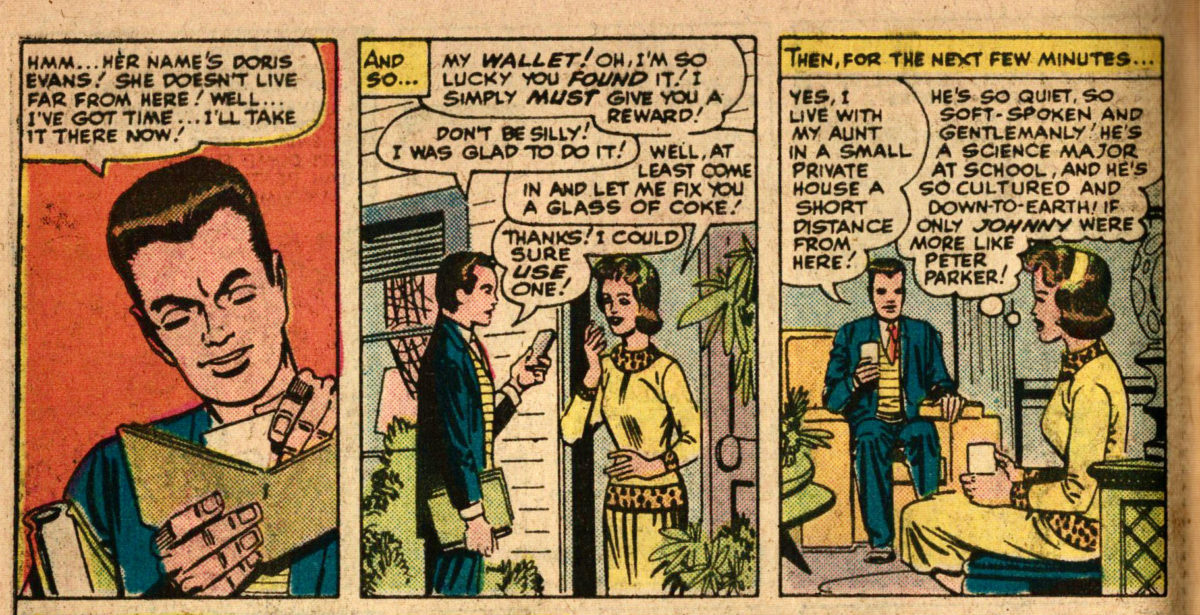
But then we come to this story. Where he falls in love with a woman he is watching.
Featuring: Spider-Man Release: May 12, 1964 Cover: August 1964 12 cents Written by: Stan Lee (because we couldn’t afford Mickey Spillane) Illustrated by: Steve Ditko (because Picasso was out of town) Lettered by: Art Simek (because his name fits this space) 22 pages
I feel like the golden era of Ditko coming up with cool Spider-Man villains may be over. At least Kraven is more interesting than Green Goblin. Like Green Goblin, it’s generally agreed the best story for each is the one where they die.
I will give Green Goblin and Kraven credit for one thing… they’re different from the other villains. They’re both unique, for better or worse.
But, while one form of Goblin or another was the villain or a background threat for the first four Spider-Man films, we’re seven films in without so much as a hint of Kraven. Guy’s gotta be a little insulted.
Kraven’s motive is different from the other villains we’ve met. He’s not interested in money, power or revenge. His goal is sport. His namesake is not an animal like many of Spider-Man’s villains, but his outfit does suggest a lion motif.
The story begins with the return of Spider-Man’s first super-villain foe: the Chameleon, who we learn is an old friend of Kraven the Hunter.
While Chameleon’s mask has the same basic idea as before, it’s been cleaned up and altered. This new look will endure for 60 years.
Featuring: Dr. Strange Release: May 12, 1964 Cover: August 1964 12 cents Written by: Stan (Miracle Man) Lee Illustrated by: Steve (Marvel Man) Ditko Inked by: George (Mystical Man) Bell Lettered by: Art (Magical Man) Simek 9 pages
This is the most cover real estate Dr. Strange has yet gotten. A full vertical half of the page. Really moving up in the world.
Stan’s “clever credits” aren’t entirely original this time. He refers to himself as Miracle Man… but that was already a name he himself gave to a Fantastic Four villain. Marvelman is the British superhero who is not actionably copied from Captain Marvel.
For the entirety of the series, as well as of Amazing Spider-Man, Ditko has done all his own art. For the best. For the next three issues, George Roussos will be inking Ditko on Dr. Strange. It is a sad sight to see.
Stan the narrator often speaks directly to the audience, and he often apologizes to them. I haven’t taken note of any apologies prior to this, but it almost seems like he’s trying to apologize that Thor looks different from normal. Because Ditko’s style isn’t Kirby’s.
Featuring: Giant-Man and Wasp Release: May 5, 1964 Cover: August 1964 12 cents Written completely by: Stan Lee Illustrated neatly by: Dick Ayers Inked discreetly by: P. Reinman Lettered sweetly by: Art Simek 16 pages
Wasp notes it’s skiing season. This note is very important for chronologists. I myself haven’t paid close attention to seasons, but experts in this field think very hard about the seasons, and how they relate to the school years of Peter Parker and Johnny Storm. The Official Marvel Index to the Avengers notes this story takes place in February, likely with references like the “skiing season” quote in mind.
It’s now been two issues since Hank bought that engagement ring, but he hasn’t mentioned it again. The relationship drama is now centered around the amount of time he spends in his lab, to the neglect of his girlfriend. She complains he has a test tube instead of a heart.
Featuring: Tales of Asgard Release: May 5, 1964 Cover: July 1964 12 cents Written with passion by: Stan Lee Drawn with pageantry by: Jack Kirby Inked with power by: Vince Colletta Lettered with pride by: Art Simek 5 pages
We recently met Vince Colletta over in Daredevil. This issue begins Vince Colletta’s long relationship with Thor, spanning almost a decade. He will be the regular inker on “Tales of Asgard” from here on out, and soon graduate to the main title. He will be the inker for over 60 consecutive issues and remain a frequent inker on the title thereafter.
Contrasting his work with, say, Chic Stone, we see more hatchings to represent shadow and shape than we have been seeing, yet less crispness. The features are often softer and less defined. I’ve seen it described as “atmospheric”.
The next two chapters of “Tales of Asgard” will focus on Balder. Let’s review his history.
Featuring: Thor Release: May 5, 1964 Cover: July 1964 12 cents Written fairly well by: Stan Lee Drawn not too badly by: Jack Kirby Inked kinda nice by: Chic Stone Lettered pretty fair by: Art Simek 18 pages
This issue picks up less than 60 seconds after the last issue ended. Cobra has stolen Thor’s hammer with a machine and Thor is about to revert to Don Blake.
I can’t believe we have another 18 pages of Thor fighting Cobra and Mr. Hyde.
This idea of spreading a story over multiple issues is becoming a thing. We made it through over a year of stories without it ever happening. Not only were stories resolved in an issue, but they were usually resolved within a dozen pages, leaving room for other stories. It takes a hefty 36 pages to conclude this battle. The famous origin of Spider-Man took only 11.
The first hint of change was the Fantastic Four battle with Dr. Doom taking place over Fantastic Four #16–17. But even that was really two distinct stories; the first just ended with Doom’s escape, so they had another Doom story right after. Amazing Spider-Man #11–12 is a similar flavor; each issue tells a complete story, but Dr. Octopus remains the villain across the issues. We’ve had the one big story, the Hulk story in Fantastic Four #25–26, which itself tied into plot threads from Avengers #2-5. But that was epic enough to justify its length. Giant-Man and Wasp inaugurated the pointless two-parter with their battle against the Human Top. Thor’s title has gone all in on the idea, as his battles with both Mr. Hyde and Tomorrow Man took two issues for no particular reason. Iron Man recently followed suit with his battle against Mandarin, also stretched over two issues.
The multi-part story will soon become the rule rather than the exception, including two giant upcoming epics. These multi-part arcs make deciding on a reading order difficult. In general, I’ve been trying to go month by month, but I’d also like to keep these multi-part stories together, which is going to require some shifting around.
Featuring: Tales of Asgard Release: April 2, 1964 Cover: June 1964 12 cents Written by: Stan Lee Illustrated by: Jack Kirby Inking: Geo Bell Lettering: Art Simek 5 pages
Recall that last issue, we learned the origin of Heimdall. This issue we get another Heimdall tale, before the spotlight shifts to Balder starting next issue.
Nedra hatches a plot with Brimer, King of the Storm Giants, to invade Asgard, even under Heimdall’s watch. Nothing can escape his sight or hearing, but the air creatures known as the Vanna can be neither seen nor heard.
Nonetheless, Heimdall senses the approaching Vanna and lashes out. He misses and is uncertain whether to trust his own instincts.
Featuring: Thor Release: April 2, 1964 Cover: June 1964 12 cents Written by: Happy Stan Lee Drawn by: Healthy Jack Kirby Inked by: Husky Chic Stone Lettered by: Hasty Art Simek 18 pages
I really am excited that Kirby is the regular on Thor, especially when paired with a great inker like Chic Stone. I remain hopeful that the quality of the “Tales of Asgard” backups will soon be reflected in the main stories, turning around what has been Marvel’s worst title so far. Enchantress and Executioner were two good additions to the rogues gallery. And last issue we got a taste of mythic armageddon. Far more interesting than Thor fighting mobsters. I like the direction they’re going. I hope they keep it u–
Oh. Huh. Cobra and Mr. Hyde, eh.
Sigh. Ah well. Teach me to get my hopes up.
Because there are no longer sci/fi backup tales, the entire issue is dedicated to Thor. Which means they have to drag this story over 18 pages. And then they make it a two-parter! 36 pages of Cobra and Mr. Hyde.
The Avengers show up. The costumes they are wearing could be clues to where this story places amidst the Avengers comics and other titles… except they provide inconsistent evidence.
Featuring: Spider-Man Release: April 9, 1964 Cover: July 1964 12 cents Writen by: Stan Lee (The poor man’s Shakespeare) Illustrated by: Steve Ditko (The poor man’s Da Vinci) Lettered by: Art Simek (The poor man’s rich man) 22 pages
There are things to like about this comic. The new villain is pretty goofy, perfect for a one-off issue of frivolity. Bring back the Enforcers and throw in the Hulk, and you have a recipe for a fun time.
But look to this first panel. It’s very interesting. A great panel, actually. You see the villain’s mask in the foreground and the shadowed villain in the background. Spider-Man has had a few unmasking scenes of late. Electro turned out to be someone he’d never heard of. Big Man turned out to be Peter’s colleague, Fred Foswell. This opening panel suggests we will get another dramatic unmasking… except we won’t.
They will save the unmasking for a later issue. Spider-Man actually fails to decisively defeat this goofy villain. Which suggests the Green Goblin will return. A bad idea. The character might be fun for one issue, but not as a recurring villain. Especially when Spider-Man aready has such a robust rogues gallery of far more interesting characters: Chameleon, Vulture, Tinkerer, Dr. Octopus, Sandman, Lizard, Living Brain, Electro, Big Man, Enforcers, and Mysterio.
The second panel is a line that’s rather amusing with the benefit of hindsight. “I made the controls simple enough that there’s no chance of fatal error.” If you’ve read further in Amazing Spider-Man, you know he will redesign his flying device and forget that particular design principle. I had suggested this panel to my friend Brian for his Past Was Close Behind series.
The Green Goblin refers to his device as a “flying broomstick”, keeping to a magic/fairy tale theme.