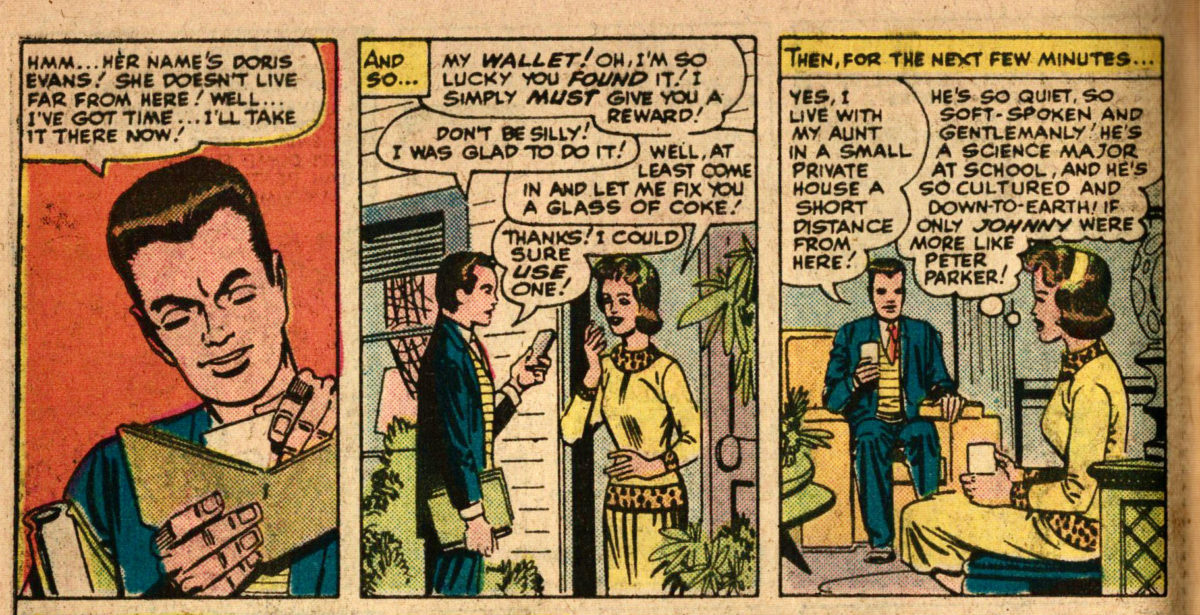
Featuring: Captain America Release: April 8, 1965 Cover: July 1965 12 cents Story and art by: Stan Lee and Jack Kirby Inking: Frank Ray Lettering: Artie Simek 10 pages
Featuring: Iron Man Release: April 8, 1965 Cover: July 1965 12 cents Written by our roguish writer: Stan Lee Pencilled by our prankish penciller: Don Heck Inked by our impish inker: Mickey Demeo Lettered by our other letter: S. Rosen 12 pages
The drama from last issue continues. Happy has quit; Pepper is sad; she blames Iron Man.
Count Nefaria of the Maggia returns, but with a new gimmick and identity. He now calls himself the Master of Dreams. Perhaps also Dream-Maker or Dream-Master; Stan can’t decide from one page to the next. He controls Iron Man’s dreams and sends old foes against him; if Iron Man dies in the dream, he will die.
Featuring: Captain America Release: March 11, 1965 Cover: June 1965 12 cents By: Stan Lee and Jack Kirby Inked by: Chic Stone Lettered by: Artie Simek 10 pages
We’ve been very slowly saying goodbye to Chic Stone, as this represents his last month with Marvel. So we’ve seen his last work on many titles already. This is his final Captain America Story. He is Kirby’s best inker on these books so far, for my money. And he will be missed.
These Captain America stories have been set in his early days. The last three issues retold stories from Captain America Comics #1, with last issue retelling the introduction of the Red Skull (and making it really lame). This issue offers a new Red Skull story. At last we learn his origin.
In the original story, Red Skull was revealed to be American industrialist George Maxon. Last issue played out similarly, (though now he was John instead of George), but it added that Red Skull was not the real Maxon. He had killed Maxon and was impersonating him. That leaves room for his new origin here. As we’ve noted before, for my purposes we are treating the post-1961 stories as canonical for this Marvel Universe. The 1940s Marvel canon is separate. So the origin of the Red Skull is what gets told here. He is not Maxon.
We learn in this issue that he had also not been impersonating Maxon. That was someone pretending to be the Red Skull pretending to be Maxon. Yeesh. And apparently Captain America is desperate to hunt down the real Red Skull based on the crimes of a fake Red Skull. Maybe?
Will the real Red Skull please stand up?
The story opens with Captain America a prisoner of the Skull. That is not where the last issue left off at all. Perhaps they will fill us in how we got here.
Featuring: Iron Man Release: March 11, 1965 Cover: June 1965 12 cents Written in the Marvel tradition of greatness by Stan Lee Illustrated in the Marvel tradition of grandeur by Don Heck Inked in the Marvel tradition of drama by Mickey Demeo Lettered in the coziest corner of the room by Sam Rosen 12 pages
Due to circumstance, I lost the write-up for this particular story I had completed. I’m not a big fan of the Iron Man stories, and I was just unenthusiastic about writing this entry again. Please excuse me if I do a poorer job than usual. I just kind of want to get through this one.
In particular, I feel like I’d previously worked out where Attuma ranks in a particular metric, and I’m not sure I care to recompute it; I’ll just go off the top of my head and let somebody correct me if I’m wrong. Iron Man is the third distinct hero Attuma has fought, after facing the Fantastic Four and Giant-Man and the Wasp. I think that might be a record?
We have to define ‘distinct’ a bit carefully. I think fighting a hero and the team that hero is on should only count as one: Sandman fought both the solo Human Torch and the Fantastic Four; Loki fought both Thor and the Avengers.
With that caveat, Attuma is only the second villain to fight three distinct heroes. The first being Chameleon, who has faced Spider-Man, Iron Man (along with the Avengers), and Hulk.
Featuring: Captain America Release: February 12, 1965 Cover: May 1965 12 cents By: Stan Lee and Jack Kirby Inking: Chic Stone Lettering: S. Rosen 10 pages
As with the last twoissues, this is closely based on a story from Captain America Comics #1. As with the last two issues, Joe Simon is not credited.
We at this point are well versed in the Red Skull stories of the 1940s and 50s. We are now primed to see the modern take on the Red Skull, beginning with this retelling of his first adventure.
There are significant changes, many with the effect to sanitize the story, make it less violent and more kid-friendly. For example, in this version the Red Skull is not a killer. The plot of the original was all about him murdering people.
I’ll note the shared story beats common to the stories.
The story begins with Private Rogers and Mascot Barnes escorting Major Croy. They warn him it’s not safe to be alone, but he dismisses them any way.
The Red Skull attacks Major Croy.
Red Skull’s henchmen loot a bank.
Captain America and Bucky track down the Red Skull, but the Skull escapes them.
Mr. Maxon is observing a test of his new plane. Private Rogers is present. When the plane crashes, likely due to sabotage, Maxon expresses concern, but not for the lives lost, which upsets Rogers.
Red Skull attacks a General, and then is revealed to be Mr. Maxon.
With that corresponding outline, there are heavy differences.
Featuring: Iron Man Release: February 11, 1965 Cover: May 1965 12 cents Story by Marvel’s merriest marcher: Stan Lee Art by Marvel’s most amiable artist: Don Heck Inking by Marvel’s dizziest delineator: Mickey Demeo Lettering by Marvel’s persnippiest pen-pusher: Sam Rosen 12 pages
We just spent several weeks reading Red Skull stories to prepare for this, and it’s an Iron Man story. What gives.
But I see Red Skull on the cover. Ah, flipping ahead, there are two stories in this comic. The second story is about Captain America and the Red Skull. Maybe we’ll get there tomorrow.
There’s a new name in the credits. Who is Mickey Demeo? Well, his real Name is Mike Esposito. He’s been working in comics since leaving the army in the late 1940s, and is best known for his decades of collaboration with Ross Andru. I know him best as an inker, but he was often the main penciller on his earlier work. He and Ross Andru started small publishers together in the 1950s, including Mikeross Publications, and MR Publications, which published Mr. Universe. Esposito and Ross had a decade-long collaboration on the character of Wonder Woman, which helped give a definitive and iconic look to the character. Together with writer Bob Kanigher, they co-created the original Suicide Squad and the Metal Men. Esposito will become a significant inker on Amazing Spider-Man, for a time in collaboration with Andru.
Why the alias? He probably doesn’t want DC to know he’s doing Marvel work. And it’s not just this title. He’s also inking this month’s Human Torch and Avengers adventures.
Here is a sampling of some early pencil work by Esposito.
Men’s Adventures #6 (Marvel, 1951)
Weird Adventures #3 (PL Publishing, 1951)
Girl Comics #8 (Marvel, 1951)
Blazing Sixguns #15 (Super Comics, 1963)
And here is some of his inking work in collaboration with Ross Andru.
Mr. Universe #2 (MR Publications, 1951)
All-American Men of War #6 (DC, 1953)
Get Lost #1 (Mikeross Publications, 1954)
Wonder Woman #58 (DC, 1958)
Brave and the Bold #25 (DC, 1959)
Showcase #37 (DC, 1962)
On to Iron Man. In this issue, Iron Man fights Iron Man!
Really, the new Iron man fights the old Iron Man.
That is, somebody steals Tony Stark’s new armor. So Tony has to put on his old armor to fight him.
Featuring: Captain America Release: January 12, 1965 Cover: April 1965 12 cents Writer: Stan Lee Illustrator: Jack Kirby Delineator: Frank Ray Letterer: S. Rosen 10 pages
This is an extremely close retelling of the second story from Captain America Comics #1, which we covered back when Captain America first returned in Avengers #4.
The original story is most notable for being Captain America’s first case and for introducing Betty Ross.
I see I didn’t go into great detail on the plot in that post, writing this:
The story of the comic doesn’t make any sense whatsoever. I can’t begin to try to explain it and I’m not sure it’s worth considering all the many ways in which it makes no sense. Suffice it to say they stop the bad guys.
We’ll delve deeper here.
Last issue was a close retelling of the first story from Captain America Comics #1, which was the story of Captain America’s origin. Next issue will be a retelling of Captain America’s first battle against Red Skull from the same issue. It makes sense why one might want to revisit those two stories. And then there’s this one.
The original stories are by Joe Simon and Jack Kirby. Joe Simon’s name should probably have been in the credits of this comic, as it’s based so closely on his original story. The plot owes more to Simon than many of the comics Stan Lee claims “plot” credit on owe to Stan.
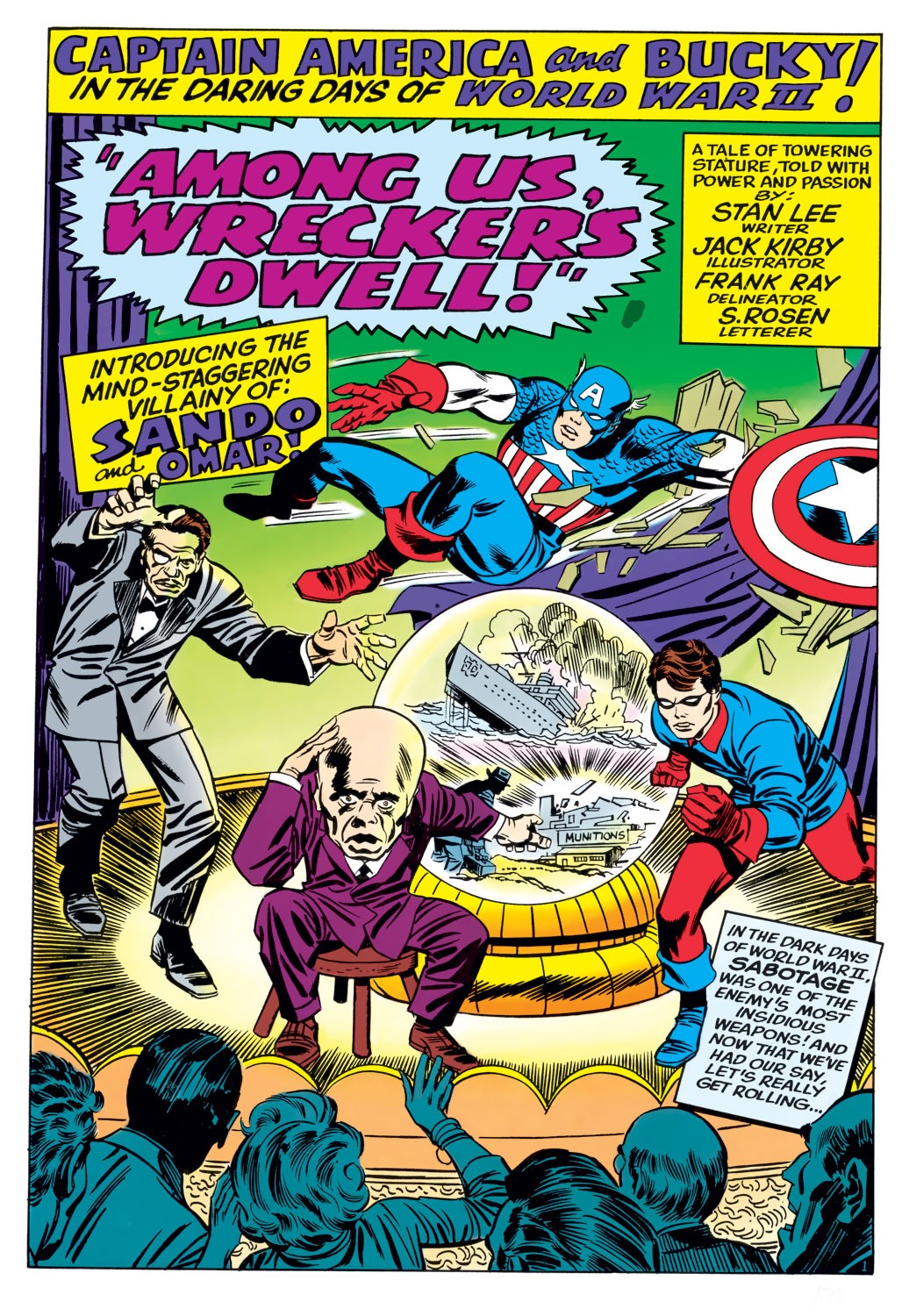
My issue with the original is that I didn’t really understand what Sando and Omar brought to the scheme. There were Nazi saboteurs in America successfully blowing things up. Why have a member of your crew go onstage and warn people about the attacks in advance by pretending to be psychic? The comic didn’t really try to explain.
Let’s compare the new one to the original. The first thing we will notice is the new one fits into very regular grid patterns that make it easy to crop out groups of panels. The original felt bound by no such structure, so the croppings will all be imperfect.
Looking to the opening splash pages, the crystal ball image is very close. The changes fit Kirby’s more dramatized style and generally make a more modern splash page. Omar is a little less freakish in the new one. The biggest loss is Sando, whose fingers had an unusual positioning in the original, almost suggesting his role as puppeteer. Kirby opted for a more standard-for-Kirby dramatized positioning.
The modern comic claims to be “introducing” Sando and Omar. This seems blatantly false, as they were obviously introduced 25 years earlier.
Featuring: Iron Man Release: January 12, 1965 Cover: April 1965 12 cents Powerful script by: Stan Lee Poignant art by: Don Heck Punchy inking by: Chic Stone Polite lettering by: Sam Rosen Plenty of kibitzing by: The Bullpen Gang! 12 pages
We just met the “new” Giant-Man. It was really just Giant-Man with a new outfit and gizmo. Similarly, the “new” Black Widow is just the Black Widow with some new gimmicks.
These gimmicks make her more formidable, but still no match for Iron Man.
She can now climb walls and fire a line of suction-tipped nylon, a web of sorts. She is a spider-themed heroine, so it makes sense her gimmicks will have hints of Spider-Man.
We also see the first hints of a possible road to redemption for Black Widow. She has decided she wishes to stop being evil and tells Khrushchev this to his face. He shows her that her parents are his prisoners, and they will be killed unless she cooperates. That Khrushchev is a villain, indeed.
Featuring: Captain America Release: December 10, 1964 Cover: March 1965 12 cents Writer: Stan Lee Illustrator: Jack Kirby Inked by: Frank Ray Lettered by: Art Simek 10 pages
Rather than trying to tell a new Captain America story, this comic will retell the origin of Captain America. Subsequent adventures will recap his earliest issues and others will be new stories set in World War II.
I can only guess what’s going on here. One, you can imagine Kirby would like a bit of a break from drawing 5 stories a month, and it may be easier on him to retell old tales. Or, perhaps he is looking back on those tales now that he has grown as an artist and is looking to revisit them and tell them better.
I also suspect that Stan is starting to notice how much his readers care about the intercontinuity of the titles, something he probably doesn’t want to think about at all. Telling Captain America stories set in the past saves him the trouble of worrying that they line up with current Avengers comics.
I tend to find the best thing to do with these retellings is just go in depth and try to spot any differences from previous tellings, particularly the original story in Captain America Comics #1 (1941).
Featuring: Iron Man Release: December 10, 1964 Cover: March 1965 12 cents Have you the nerve to read this great Stan Lee story? Should we preserve these thrilling Don Heck drawings? Dare we observe this unique Dick Ayers inking? Do we deserve the impact of this Sam Rosen lettering? 12 pages
Introduces a new villain, the Phantom, who is sabotaging Stark’s plant. I thought about naming all the Iron Man villains whose plan has involved attacking or sabotaging Stark’s plant, but it would be easier to name the rest of them.
This resolves the story arc where Tony Stark seemed to be dead. He turns out not to be.
He pretended to be dead because he was trapped in his armor. Yet… trapped in his armor, he could still remove his helmet and gloves, at least. He has always been trapped in the chest plate and just puts clothes over it. So I don’t understand why he couldn’t have just put clothes over the rest of his armor.
Whatever the explanation, he modified a transistor so now only needs the chestplate. Basically, his new invention allowed him to take his pants off.