Featuring: Captain America Release: September 8, 1966 Cover: January 1967 12 cents A Stan Lee Jack Kirby premium presentation Inimitable inking by: Frank Giacoia Laborious lettering by: Sam Rosen 10 pages
Indeed, eet shall be for zee last time, mon ami…! For none may strike Batroc in such a manner… wizout paying zee price!
“This must be the place,” thinks Cap, anticipating David Byrne.
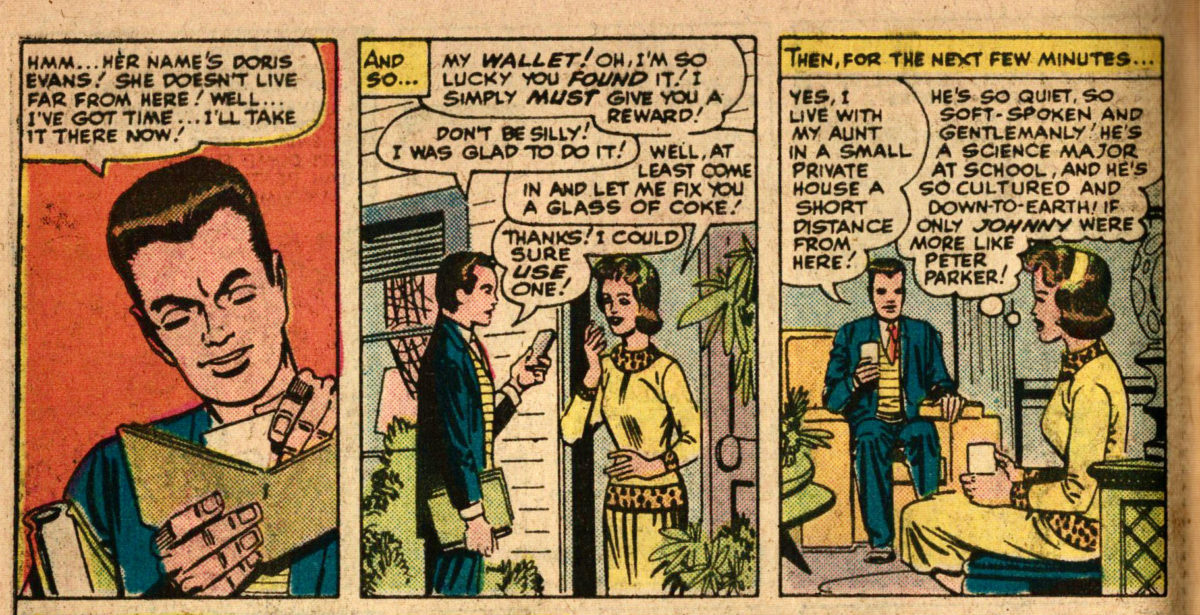
In Tales of Suspense #76, Captain America defeated Batroc, but a SHIELD agent on assignment succumbed to poison and was hospitalized. We didn’t learn her name. She reminded Cap of a woman he’d known in World War II, a woman whose name we also didn’t learn.
Featuring: Captain America Release: January 11, 1966 Cover: April 1966 12 cents Script: Smilin’ Stan Lee Art: Jazzy Johnny Romita Lettering: Adorable Artie Simek 10 pages
Is this my destiny? To have been given a second chance at life– only to lose everything I ever held dear? First, it was Bucky, the greatest sidekick a man ever had! Then, those many years ago, I can still remember her– promising to wait– no matter how long it might be-! Now– when I thought I had found her reborn– I’ve lost her again! And perhaps this time– it will be– forever!
For a story that’s introducing a pretty woman to Cap’s world, the late John Romita seems like the perfect artist. Though the woman is barely in this comic.
In fact, we’ve seen John Romita’s work on Captain America before way back in the 1950s, in his early days as an artist.
Romita won’t be returning to Cap regularly. He’s just filling in for Kirby here. He’s already the regular artist on Daredevil and may be taking over another title soon.
Recall where we left off. This Agent of SHIELD may be the younger sister of Cap’s WWII sweetheart. We don’t know her name. She has Inferno 42 and is protecting it from Batroc, but doesn’t realize it’s cracked and set to destroy New York within half hour. Cap and Batroc have teamed up to save the city.
Featuring: Captain America Release: December 9, 1965 Cover: March 1966 12 cents Stan Lee, script Jack Kirby, layout Dick Ayers, pencil J. Tartaglione, inks Artie Simek, lettering Irving Forbush, cheerleader 10 pages
But, there was one other! Our lives touched for only a short time– but I’ve never forgotten her! I can still remember our final date– when she whispered to me thru trembling lips… “I’ll wait till you return, Steve! No matter how long– no matter what happens– I’ll wait for you, my darling…!”
We read this issue’s Iron Man story a little while ago, in which Happy had turned into a Freak. We saved this story to make sure it tied into to the issue of Strange Tales that referenced it.
It was a tricky call for reading order, as I don’t like to separate issues, so I’d prefer to have read this story with the Iron Man story, and continuity-wise, the issue of Strange Tales we’re tying into doesn’t fit in where we left off with the Iron Man story. But I just couldn’t find a good way to juggle all the things I’m juggling to assemble a reading order.
This is a good comic with lots going on to talk about. I had to make a checklist for myself to ensure I covered the 10 most important points.
Though we’d taken a pause in reading Cap’s story, there is no break between the beginning of this story and the end of the last. As we open, Cap is hurtling toward the sea after the defeat of the Sleepers.
Except last seen, he had a working parachute. Sometime between the issues, his parachute seems to have failed, so we get a dramatic opening.
We cut to some shadowy figures observing a test of Inferno 42. Nick Fury was aware of this item and had sent an agent to retrieve it. We learned this in Strange Tales #142. Also in that story, Fixer referred to a mysterious organization that was his benefactor, known as Them. Is that who these shadowy figures are?
Back to Cap, we get a great moment. The sailors are in awe of him. One had idolized him as a child.
I have a notion in my head of who these characters are, formed from reading decades of comics beyond these. Cap inspiring awe in those around him is part of my basic image of Cap. But it’s not necessarily something we’ve seen a lot of in these early comics. We did see examples in Cap’s return in Avengers #4. But it’s not yet that common, so every such example is notable, as together they will form the basis for that aspect of Cap’s character.
Featuring: Captain America Release: January 12, 1965 Cover: April 1965 12 cents Writer: Stan Lee Illustrator: Jack Kirby Delineator: Frank Ray Letterer: S. Rosen 10 pages
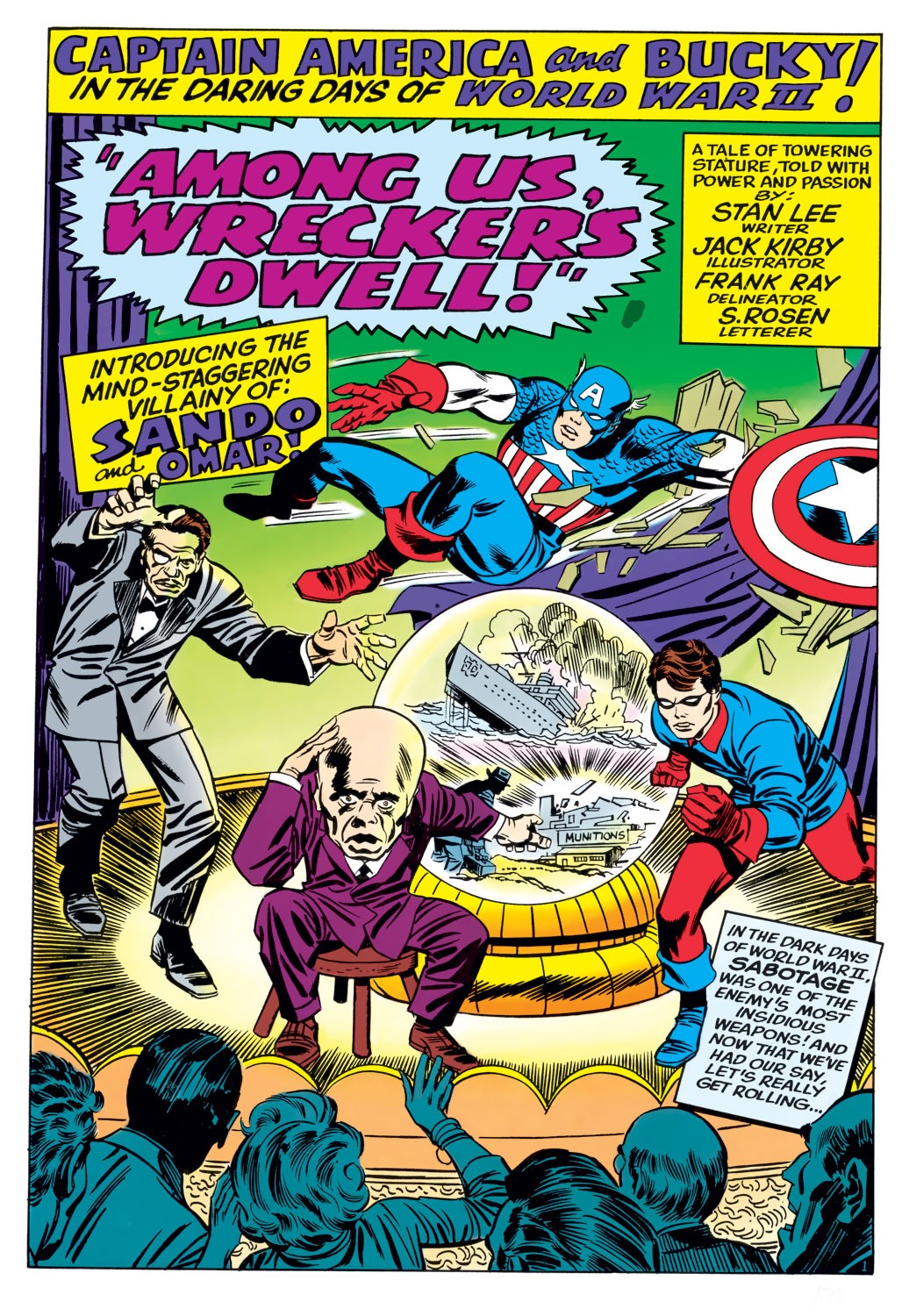
This is an extremely close retelling of the second story from Captain America Comics #1, which we covered back when Captain America first returned in Avengers #4.
The original story is most notable for being Captain America’s first case and for introducing Betty Ross.
I see I didn’t go into great detail on the plot in that post, writing this:
The story of the comic doesn’t make any sense whatsoever. I can’t begin to try to explain it and I’m not sure it’s worth considering all the many ways in which it makes no sense. Suffice it to say they stop the bad guys.
We’ll delve deeper here.
Last issue was a close retelling of the first story from Captain America Comics #1, which was the story of Captain America’s origin. Next issue will be a retelling of Captain America’s first battle against Red Skull from the same issue. It makes sense why one might want to revisit those two stories. And then there’s this one.
The original stories are by Joe Simon and Jack Kirby. Joe Simon’s name should probably have been in the credits of this comic, as it’s based so closely on his original story. The plot owes more to Simon than many of the comics Stan Lee claims “plot” credit on owe to Stan.
My issue with the original is that I didn’t really understand what Sando and Omar brought to the scheme. There were Nazi saboteurs in America successfully blowing things up. Why have a member of your crew go onstage and warn people about the attacks in advance by pretending to be psychic? The comic didn’t really try to explain.
Let’s compare the new one to the original. The first thing we will notice is the new one fits into very regular grid patterns that make it easy to crop out groups of panels. The original felt bound by no such structure, so the croppings will all be imperfect.
Looking to the opening splash pages, the crystal ball image is very close. The changes fit Kirby’s more dramatized style and generally make a more modern splash page. Omar is a little less freakish in the new one. The biggest loss is Sando, whose fingers had an unusual positioning in the original, almost suggesting his role as puppeteer. Kirby opted for a more standard-for-Kirby dramatized positioning.
The modern comic claims to be “introducing” Sando and Omar. This seems blatantly false, as they were obviously introduced 25 years earlier.
I’ve spent the last several weeks reading along to the Falcon & Winter Soldier TV series, another excellent show to come out of the Marvel Cinematic Universe. With the show finished last week, I’d like to share the comics the show inspired me to revisit: the adventures of Falcon and Winter Soldier, John Walker, the Power Broker, Flag Smasher, Batroc, Zemo, etcetera.
I also found myself very interested in the idea of the mantle of Captain America, and what happens when the shield passes to the hands of another. It turns out that happens all the time in the comics. We’ll read through at least 10 different times when somebody else has wielded the shield.
Let’s read some comics.
This post is broken into 4 pages.
Page 1: 1941-1979. Meet Captain America, Bucky, Zemo, Batroc, Sharon Carter, Falcon, and Contessa Valentina Allegro de Fontaine.
Page 2: 1972-1988. Meet 4 other heroes to assume the identity of Captain America. Visit Madripoor; learn about the Power Broker.
Page 3: 1985-1992. Meet the Flag Smasher. See John Walker become Captain America, with Battle Star as his partner.
Page 4: 2003-2020. Meet Isaiah Bradley, the true Captain America of the 1940s. Then see Bucky Barnes assume the mantle of Captain America. Then see Sam Wilson do the same. We end with some reading recommendations.