Featuring: Human Torch Release: March 12, 1963 Cover: June 1963 12 cents Plot: Stan Lee Script: R. Berns Art: Jack Kirby Inks: Dick Ayers 13 pages
I read this story in Marvel Masterworks: The Human Torch vol. 1.
The Sorceror is a hermit who is mean to kids who trespass on his property. In return, Johnny is extremely mean to him. I thought Johnny was being quite the bully to a harmless hermit who just wants to be left alone.
Now who’s abusing his power?
Torch tells him: “You can’t have it both ways. If you want freedom of movement, others must have it as well!” But that hardly makes sense. In context, Torch is saying: “If you want to leave your own property, you have to let others onto it.”
Anyways, the Sorceror is not harmless. He’s actually a sorceror and has found Pandora’s Box. Which contains a bunch of evils, also called imps. We meet some of them: Flood, Hatred, Forgetfulness, Sleepiness, Paralysis, Cold, Disease, Foolishness, Laziness, Fire, Fear. They range from human traits to natural disasters.
We learn a bit of Greek myth, how Pandora released the evils but Circe put them back. Not clear what connection Circe will have to the Eternal named Sersi we will eventually meet.
Always a woman. Eating that apple. Opening that box.
In the last post, we spoke about characters getting ruined by having lame ambitions. The Sorceror has access to all the evils of the world. And what does he want to do with it? Rob a bank. Boring.
Have better ambition!
Has it been 2 years already?
The most interesting thing in this story to me is that Johnny notes it’s 1963. He had noted in an issue of Fantastic Four that it was 1962, suggesting at least a year has passed. I am fascinated by trying to track how much time has passed and am looking for clues. But I must be careful reading too much into a single line of dialogue stating the year. As writers will almost always claim their story is happening in the current year, whether or not that makes sense.. But Reed is already in his ’40s by 1961 when we meet him. So he only has so many decades of superheroing left in him.
Rating: ★★☆☆☆, 39/100
Characters:
Johnny Storm/Human Torch
The Sorcerer
Flood
Ben Grimm/Thing
Reed Richards/Mr. Fantastic
Sue Storm/Invisible Girl
Pandora
Circe
Hatred
Forgetfullness
Sleepiness
Paralysis
Cold
Disease
Foolishness
Laziness
Fire
Fear
Story Notes:
Johnny notes it’s now 1963
The box contains hundreds of imps
In end, Sorcerer frozen with fear from Imp of Fear
In an earlier story in this same issue, we saw Human Torch battle the Painter.
We read one earlier Merlin story in the pages of Tales of Suspense, also by Lee and Ditko. That was a modern tale, whereas this one takes us back to Arthurian days.
This era of these “weird tales” is soon coming to an end, as their pages will be given over entirely to these upstart superhero comics soon. We’ve read the occasional one, usually featuring legendary figures who will also appear in our superhero stories.
Merlin is actually quite the important character to our Marvel tales, featuring prominently in Black Knight and Captain Britain tales, though it’s not clear this issue is meant to have any connection. There was a short-lived 50s series called Black Knight in which Merlin was a major character, which will be quite important to our tale. We’ll read a couple of those stories as Prelude issues when they start to impact the stories we are reading here. They were also set in King Arthur’s court.
This is the tale of the jealous Sir Mogard, who challenges Merlin to a duel. Just as we saw in the last Merlin tale, the villain gets what’s coming to him.
Don’t hear the word “bandy” often; last time I heard it was from Gandalf.
This tale also involves a Black Knight, who in the classic series served Merlin against Modred. The original Black Knight was Sir Percy in disguise. This one turns out to be an empty suit of armor brought to life by Merlin. There will be other Black Knights to come.
Featuring: Human Torch Release: February 12, 1963 Cover: May 1963 12 cents Plot: Stan Lee Script: R. Berns Art: Jack Kirby Inking: Dick Ayers 13 pages
Kirby is back with Ayers inking after 2 issues of Ayers on main art. They will go back and forth some, but Ayers is going to be the more regular artist at this point. This is the second script we’ve seen by “R. Berns”, Robert Bernstein, who just provided the script for the last Iron Man story. We’ll see him in a few more places.
The basic idea of this comic is fun. The Painter has magic paint that makes whatever he paints come to life. The ending is somewhat absurd, and the story has some severe structural problems.
The splash page is pretty heavily expository and overly explains the plot of the issue, when really it should just be teasing it.
I mean… that’s pretty much the entire story.
We get a couple pages showing how Human Torch regularly helps police capture common crooks. This isn’t the type of thing we see any other FF members doing. It’s a regular activity for Ant-Man and semi-regular activity for Thor.
Human Torch battles Sub-Mariner for no particular reason!
Face-to-Face with Prince Namor, the Mighty Sub-Mariner Featuring: Human Torch Release: January 10, 1963 Cover: April 1963 12 cents Plot: Stan Lee Script: Larry Lieber Art: Dick Ayers 13 pages
I read this story in Marvel Masterworks: The Human Torch vol. 1.
Dick Ayers is again the main artist. Kirby will be back next issue, but they will trade art duties for the remainder of the series. This is the pattern we have been seeing. Kirby is still around and will sometimes provide the art for the series he pioneered, but will be rotating with other artists. Heck has Ant-Man and Ayers has Human Torch.
This fairly useless series continues. The Fantastic Four series hasn’t once yet acknowledged anything about this series’ existence, including Sue and Johnny’s home in Glenville. In contrast, this series references lots of things about the Fantastic Four. The whole team has a cameo in this issue and there are references to the FF battles against Namor. You can tell which series is the ugly stepchild.
As the story–such as it is–begins, we find the three adult FF members had a meeting while Johnny was in school. They were taking notes on next month’s adventure, while Sue typed them up. It’s a bit odd, as most FF adventures are their responses to crises. It’s not clear what they’d be planning a month in advance.
Nice to see that even Sue had a role in the meeting…
The current issue of Fantastic Four came out a week earlier. We haven’t read it yet, because issue 14 picks up where it leaves off, so I’m reading it last this month. That adventure is a trip to the moon. Which does take some planning; however, in the issue itself, the trip is a surprise to the rest of the team. Only Reed had been planning it and had been planning not to take the others. So they must be referring to something else.
The Threat of the Torrid Twosome Featuring: Human Torch Release: December 10, 1962 Cover: March 1963 12 cents Plot: Stan Lee Script: Larry Lieber Art: Dick Ayers 13 pages
I read this story in Marvel Masterworks: The Human Torch vol. 1
This blog took a short hiatus while I traveled a bit. I did bring my Human Torch book along with me with the idea of getting this written while abroad, but I didn’t get it done. It doesn’t help that we’ve now read Amazing Spider-Man, so know how good a superhero comic can be. That doesn’t make it easy to return to these Human Torch comics.
This is the first Human Torch story not drawn by Kirby. Regular inker Dick Ayers is stepping up as the main artist. That’s a common theme for the month. After 18 months of Kirby drawing all the titles we’ve been reading, he’s dialing it back. We just saw Don Heck on Ant-Man and Iron Man.
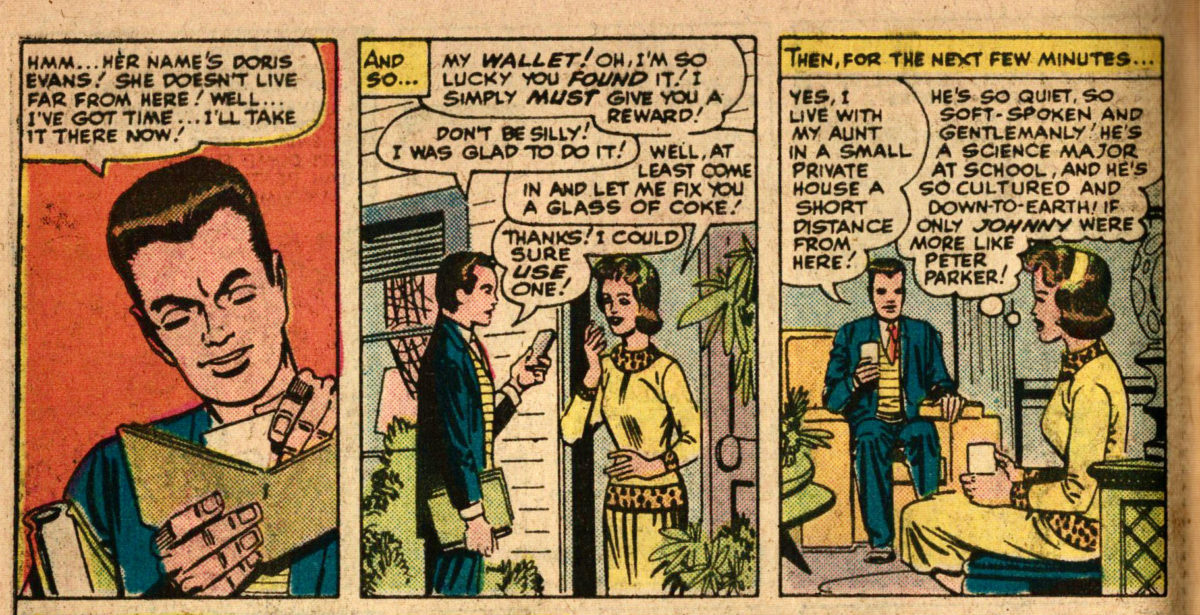
This story finally addresses–albeit clumsily–the nagging flaw at the heart of this series: the secret identity of the Human Torch. We learn that he does not in fact have a secret identity, and that all his friends were pretending to not know his identity to be nice. That doesn’t explain a lot of things, like why the Torch so frequently risked lives to protect his identity, why he was so open and cavalier about his identity in theFantastic Four comics, or why the Wizard’s plan depended so heavily on the Human Torch guarding his identity.
The Return of the Wizard! Featuring: Human Torch Release: November 8, 1962 Cover: February 1963 12 cents Plot: Stan Lee Script: Larry Lieber Art: Jack Kirby Inking: Dick Ayers 13 pages
I read this story in Marvel Masterworks: The Human Torch vol. 1.
It’s time to reflect back on this series so far: it’s not very good. Now, the Fantastic Four comic is pretty good. This has the same creators and features a character from that comic. But they don’t seem to be bringing their A-game to this title.
There’s a couple things to notice about the Fantastic Four comics. The first is that Johnny has a pretty minor role in those stories. Most of the focus and character development is on Reed and Ben. Those are the characters Lee and Kirby seem interested in, notably the two male characters about their age, as opposed to the woman and teenager, who almost seem to be there as token characters.
Also, notice the Fantastic Four comic never gives any hints that this series exists. It’s never mentioned Glenville. Johnny continues to be open about his Human Torch identity there, while hiding it here. Johnny seems to always be in the Baxter Building; it seems like he lives there. Johnny’s solo adventures are just never mentioned.
The Human Torch Meets Paste-Pot Pete! Featuring: Human Torch Release: October 9, 1962 Cover: January 1963 12 cents Plot: Stan Lee Script: Larry Lieber Art: Jack Kirby Inking: Dick Ayers 13 pages
I think it goes without saying that Paste-Pot Pete is one of the greatest super-villains of all time. And that he has one of the greatest names. And therefore– I will say no more.
Prisoner of the 5th Dimension!/Trapped in Another World! Featuring: Human Torch Release: September 11, 1962 Cover: December 1962 12 cents Plot: Stan Lee Script: Larry Lieber Art: Jack Kirby Inking: Dick Ayers 13 pages
I read this story in Marvel Masterworks: The Human Torch vol. 1.
Once again, we see Stan is giving full credits for the art team, including the letterer Art Simek. Stan credits himself with the plot, but I’ll add some notes based on my general understanding of the usual working relationship; they details of this have been debated by lawyers and historians for decades, so take my musings as those of a non-expert relating what he’s heard. It was very common that Kirby also usually made significant plot contributions, despite the lack of annotation in the credits. The general working arrangement would be that Stan and Jack would talk out ideas together in loose terms, then Kirby would go draw the comic, which includes most of the storytelling details, and then the script and final inks would be filled in after. The busier Stan got, the looser those initial planning conversations were, and the more plotting work was left to Kirby when he was drawing the comic.
Prisoner of the Wizard/Wizard’s Wiles! Release: August 9, 1962 Cover: November 1962 12 cents Writers: Stan Lee and Larry Lieber Penciler: Jack Kirby Inker: Dick Ayers 13 pages
This is better than the previous Human Torch story. It at least introduces a notable villain. And Wizard is a pretty cool character.
But, man, that secret identity thing remains a rough plot point. First, the ultra-genius Wizard needs a convoluted plan to find the Torch because nobody knows his secret identity. And then, Wizard douses Torch’s flames to defeat him, but only on his body… leaving a flaming head. Why?