Featuring: Fantastic Four Release: November 11, 1965 Cover: February 1966 12 cents Story: Stan Lee Art: Jack Kirby Inking: Joe Sinnott Lettering: Art Simek 20 pages
If ya got a few spare minutes, it’s time fer us ‘ta save humanity again!
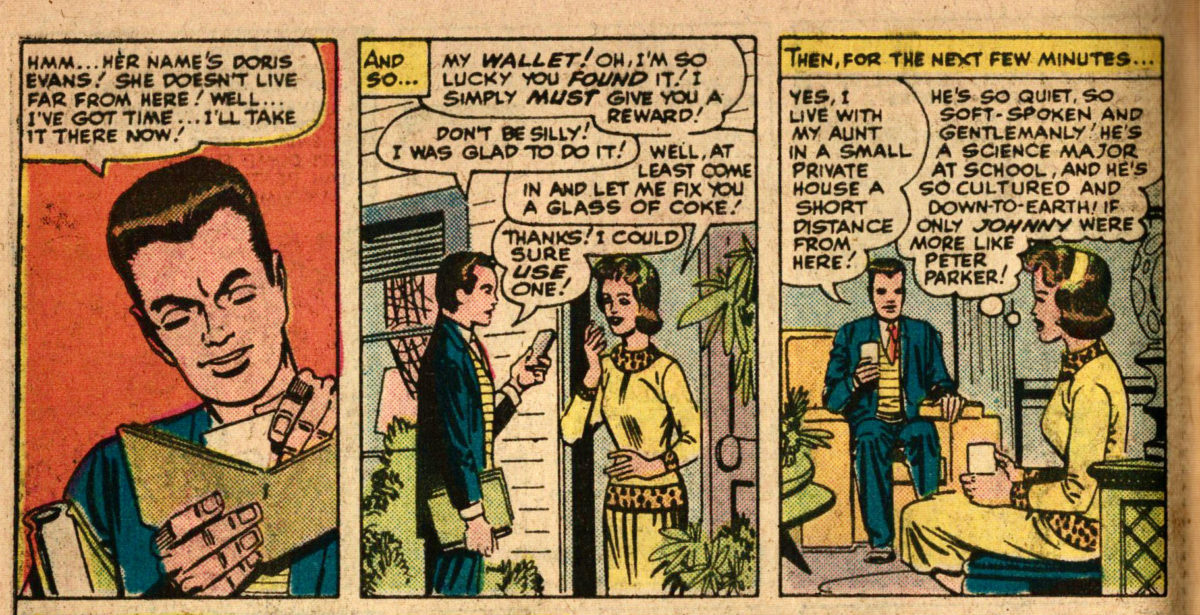
All Johnny can think about is Crystal. Guess we’re over Dorrie. Also, a man is dying. Luckily, Sue is there to point out Triton needs to get to water immediately. Johnny’s head is elsewhere. He’s only thinking with his, let’s say, heart.
The Great Refuge is the home of the Inhumans. They are ruled by Maximus the Magnificent. He had ordered the Seeker to return the others, such as Triton. He had ordered Gorgon to bring Medusa to the Great Refuge. He wanted Medusa back so he could marry her.
Featuring: Fantastic Four Release: October 12, 1965 Cover: January 1966 12 cents Story by our leader, Stan Lee Illustrations by our idol, Jack Kirby Inking by our star, Joe Sinnott Lettering by our letterer, Artie Simek 20 pages
Who is Black Bolt? He’s fast. He’s strong. Strong enough to stagger the Thing with one blow. The antenna on his mask converts electrons into his strength and speed.
Featuring: Fantastic Four Release: August 10, 1965 Cover: November 1965 12 cents Dreamed up by: Stan Lee Sketched down by: Jack Kirby Inked in by: Joe Sinnott Lettered around by: S. Rosen 20 pages
I’ve had enough of this domestic bliss bit! Hanging around here is like being on the set of Ozzie and Harriet!
“The world’s greatest comic magazine!” That’s what is says on the cover. Despite being a comic not as good as the company’s own Dr. Strange or Spider-Man stories. But it’s always been one of Marvel’s best comics and has gotten continually better. We’ve noted assorted leaps forward in quality, such as in issues 13, 29, 35, 36, 38, 39… At some point, we enter into the great era of Fantastic Four. And if we weren’t there already, we’re definitely there now.
One missing ingredient was Joe Sinnott on inks. Often cited as Kirby’s best inker. He’s not entirely new, as he inked the introduction of Dr. Doom back in issue 5. He’d also been the regular artist on Thor for a bit, but did a pretty terrible job. He later recalled in interviews that he hadn’t realized at the time anybody expected these comics to be good. He took the Thor assignment as a job to churn out some disposable work. He seems to take this Fantastic Four assignment more seriously.
Featuring: Fantastic Four Release: May 11, 1965 Cover: August 1965 12 cents Story by: Stan Lee, who has never lost his touch! Art by: Jack Kirby, who has never lost his magic! Inking by: Vince Colletta, who has never lost his flair! Lettering by: Sam Rosen, who has never lost Artie Simek! 20 pages
You did this to me, Richards!! You turned me into somethin’ so ugly that they can only call me… a Thing!
I appreciate that they use Ben’s real name in the title, rather than his superhero name. It adds a certain something, though I suspect Stan did it for alliterative purposes: brutal, betrayal, Ben.
Notice this picks up right where the last issue left off, so no time has passed. Yet we’ve read 7 other comics in the meantime. The idea is all this stuff is happening close to concurrently.
Ben had been turned human again, but Reed felt they needed him to be super strong again to defeat Dr. Doom, so without permission, Reed fired a ray to turn him back into the Thing.
Ben is justifiably angry and quitting the Fantastic Four.
Featuring: Fantastic Four Release: March 11, 1965 Cover: June 1965 12 cents Splendiforious story by: Stan Lee Delectable drawings by: Jack Kirby Deliciious Delineation by: Frank Ray Laconic lettering by: Artie Simek 20 pages
I don’t normally post things on Sundays, so I had planned this for Monday. But today is April 10, 2022. And it just seemed too fitting not to post this today, in honor of the introduction of Dr. Doom, April 10, 1962. Here’s the post we did on his introduction almost 3 years ago.
So, happy birthday to the greatest comic book villain of all time. Let’s celebrate by reading his first truly great battle against the Fantastic Four, still one of the greatest Dr. Doom stories ever.
Just don’t mention his age to him. He’ll probably kill you. He can be a bit vain.
After a battle with the Frightful Four, the Fantastic Four were caught in a Q-bomb explosion and left for dead in the middle of the ocean. When we last saw them, it appeared as though Ben was turning human again.
To me, that’s a good excuse to jump straight to the next issue where they are getting dragged out of the water.
But we didn’t do that. We read another 35 comics in between the two. Why? Well, a lot was happening all at once. While they were still at sea, the Frightful Four showed up in Thor’s comic during the Trial of the Gods. That’s a whole thing. That tied into this Daredevil/Sub-Mariner battle as well as to this milestone Avengers issue where a new team of Avengers formed. That spun out of an X-Men story which happened before Human Torch showed up in the pages of X-Men. It’s tightly connected.
Obviously, the FF couldn’t be at sea that many days without the submarine finding them. They need water at some point. But it could have taken a bit of time to get back to their headquarters. And all the other superhero adventures must have elapsed in that time.
Frank Giacoia is the credited inker (under the pen name Frank Ray), but Wally Wood was brought in to ink Daredevil specifically, to ensure consistency with Daredevil’s look across the books.
Featuring: Thor Release: March 4, 1965 Cover: May 1965 12 cents Written by imperial Stan Lee Illustrated by impregnable Jack Kirby Inked by implacable Vince Colletta Lettered by impossible Artie Simek 16 pages
Colletta graduates from inking the backup stories to the main Thor feature. He will be the Thor artist for a very long time to come. For better or worse. In fact, he will ink the next 52 consecutive Thor stories, and a good many of the next 50 after that over the course of an 8-year run.
We’ll reserve commentary on the his style for now. Let’s spend a few issues taking in this new art style before we try to see how we think Colletta compares to Chic Stone.
Another compelling Thor title. “The Trial of the Gods!”
We’ve known the phrase since we read Avengers #16, which was actually published a week after this, but took place earlier. At least, Thor’s appearance in the story took place before this issue.
Kirby seemed to use the same concept for cover and first page.
I’ve never really understood Odin and never will. Everybody seems to agree he is wise, but his wisdom must be too much for my mortal intelligence to grasp. Thor claims Loki kidnapped Jane to Asgard; Loki claims Thor brought Jane to Asgard because he loves her. Who is lying? The God of Thunder or the God of Lies?
Only one way to find out, says Odin. The Trial of the Gods!
Featuring: Fantastic Four Release: December 10, 1964 Cover: March 1965 12 cents Proudly produced by: Smilin’ Stan Lee and Jolly Jack Kirby Inked by: Chic Stone Lettered by: Artie Simek 21 pages
The main credits are shared between Stan and Jack without specifying who did what.
Fantastic Four has been one of the best of these Marvel superhero titles since the start, but it’s regarded as one of the best comic series ever, which hasn’t yet been obvious. The series gets better at some point. It can be hard to pinpoint the exact point of transition. We noted issue 29 when Kirby started using photo collages as a step toward greatness. The introduction of the Frightful Four in this issue also suggests we are well down the path. Particularly the mysterious Madam Medusa.
Sue and Reed announced their engagement last issue. They’ve now made a public announcement, and the press is excited, underscoring their celebrity status. There will be a big engagement party this issue.
Also, I think Sue’s gotten a haircut. Her hair definitely seems shorter.
Featuring: Avengers Release: January 3, 1964 Cover: March 1964 12 cents Gloriously written by: Stan Lee Grandly illustrated by: Jack Kirby Gallantly lettered by: Art Simek 23 pages
No inker is given in the credits for some reason. The GCD suggests the inker is George Roussos, who has been doing a lot of inking lately under the pseudonym George Bell. I don’t think we’ve yet seen a single comic where Kirby has done his own finishes. Probably because he’s drawing a half dozen comics each month.
There’s something that troubles me about these credits, and it’s the type of thing that makes Stan Lee a controversial character to this day. Look to the acknowledgement on this first page. Stan notes that Jack drew the original Captain America comics. That’s true and good to point out. But that massively understates Kirby’s contribution. Kirby and Simon created Captain America. The box should say. “Jack Kirby is one of the creators of Captain America.” Now, this may have been mere thoughtlessness on Stan’s part. Kirby used to draw Captain America and now is drawing him again; Stan used to write Captain America and now is writing him again. That may be the only point he wanted to make, and perhaps no other thoughts occurred to him. But the phrasing seems careful, and reflects the longtime legal stance of the many companies that have owned Marvel, that people don’t create characters, companies do. You can read an article from Brian Cronin on a piece Stan Lee had written in 1947 crediting publisher Martin Goodman with the idea for Captain America. The piece is basically fictional. Joe Simon came up with the character independently, and Kirby helped him flesh out the details. Stan’s failure to credit them for that goes back a long ways.
Featuring: Captain America Release: October 28, 1942 Cover: December 1942 10 cents 15 pages
I don’t see any credits. Except for the publisher and “editorial and art director”. The GCD credits the art to Al Avison and Syd Shores.
“Jap Buster Johnson”? Ouch.
We continue our survey of early Captain America comics in preparation for Avengers #4. We started out with some significant milestones and will mostly focus on significant milestones. But I wanted to get a sense of who Captain America was in a run-of-the-mill story, not in any way a milestone. This story fit the bill for its insignificance.
It was chosen specifically because there is a connection to Medusa, which will also tie into Avengers #4.
Featuring: Medusa Release: July 2, 1963 Cover: September 1963 12 cents Story plot: Stan Lee Script + Art: Larry Lieber Inking: Paul Reinman 5 pages
Wet met Medusa in Tales to Astonish #32. As with all these mythological characters, it is unclear if all the stories that appear are supposed to connect. The CMRO includes many Medusa appearances in its order, including several appearances that predate where we started our reading. I hope to cover USA Comics #6 eventually in a “prelude” post, but after we first meet Captain America in the present stories.
For example, this comic notes Medusa was slain by Perseus, suggesting she is not the same character we met in the modern day. On the other hand, the Perseus story was related by a teacher, who is perhaps just wrong about Medusa’s fate.
Either way, we learn Medusa is a member of an alien race called the Gorgons, who are now ready to invade earth once again.