Featuring: Hulk Release: January 5, 1965 Cover: April 1965 12 cents Power-packed script by: Stan Lee Hard-hitting art by: Steve Ditko Two-fisted inking by: Vince Colletta Silken-soft lettering by: Art Simek 10 pages
We are almost up to date with our Hulk stories. This is the last issue where we’d read the Giant-Man/Wasp stories in the past.
We just had a discussion about how Colleta’s inking over Kirby.
How do we feel about Colletta over Ditko? The answer is that we dislike all inkers over Ditko. Ditko is best when inking himself. However, the final artwork here looks close enough to Ditko work. Ditko must have done tight pencils. So we don’t hate it. But we don’t prefer it.
Featuring: Hulk Release: December 3, 1964 Cover: March 1965 12 cents Written by: Stan Lee (our faithful writer!) Drawn by: Steve Ditko (our reliable artist!) Inked by: Dick Ayers (our dependable inker!) Lettered by: S. Rosen (our other letterer!) 10 pages
Our saga continues. Stan offers a recap. Hulk and Talbot are on Astra Isle with a new nuclear device of Dr. Banner’s. Hulk is fighting the Leader’s humanoids and a Marine task force is closing in.
We know now that strain triggers the transformation. When Dr. Banner feels strain, he turns into the Hulk. And when the Hulk feels too much strain, he turns back into Dr. Banner.
Now that Roussos has moved on, Ditko will have rotating inkers to finish off his run on the Hulk. Of course, Ditko’s work looks its best when he inks himself.
The cliffhanger of last issue resolves by page 2 as Hulk and the Humanoids fall into the ocean.
This leads to the actual plot of this issue. Banner is rescued by a Soviet sub and taken to an unnamed Soviet country as a prisoner.
Featuring: Hulk Release: November 3, 1964 Cover: February 1964 12 cents Written with the sparkling skill of Stan Lee! Drawn with the peerless power of Steve Ditko! Inked with the classic clarity of George Bell! Lettered with the TV set on by: Artie Simek 10 pages
Recall we read the Giant-Man/Wasp story in this issue a while back, but we’ve saved the Hulk stories for a big push.
Interesting that Stan refers to this as “the only super-hero soap opera”. I feel like that phrase with epitomize Marvel comics for decades to come.
I think it’s time to bid farewell to George Roussos, one of the most prominent inkers of our early reading, always under the pseudonym George Bell (oft abbreviated to Geo. Bell). We’ve read almost 50 stories with his inks, including Fantastic Four, Sgt. Fury, Iron Man, Thor, Human Torch, Giant-Man/Wasp, and Hulk stories. He’s off to do other work. He’ll return to Marvel in the 1970s and become one of Marvel’s most prominent colorists. He’s also been coloring much of the work we’ve been reading, but I’ve read most of his stories in recolored reprints, so miss out.
We open with Banner in jail, suspected of treason. He is taking tranquilizer pills to keep himself from transforming. Remember, it’s now strain that triggers the transformation.
Featuring: Hulk Release: October 1, 1964 Cover: January 1965 12 cents Only Stan Lee could have written this monumental masterpiece! Only Steve Ditko could have drawn these powerful panels! Only Geo. Bell could have inked this sensational saga! Only S. Rosen would have lettered his name S. Rosen! 10 pages
We’re nominally on the March books, but we just got up to June with Thor comics and July with X-Men, and now we need to go back to October of 1964 for Hulk stories.
We read the first story of this issue a while back. We’ve been skipping the Hulk stories because they are so intertwined with each other. Hulk is in the middle of a saga that really began in issue 60. We’re going to try to do the whole saga in something like three chunks.
Let’s review the story so far.
Dr. Bruce Banner is a weapons builder on a military base who is frequently absent. General Thunderbolt Ross has little patience for Banner and is uspet his daughter Betty seems so fond of the “weakling”. Of course, Bruce is also the Hulk. He recently decided that strain was the trigger of his uncontrollable changes into a monster with its own personality.
Dr. Banner has built a robotic suit, but a spy has stolen it. Hulk fights the spy in the robot suit. After a couple encounters, the robot is tossed into a bottomless pit.
Major Glen Talbot has been hired as the chief of security, with a particular remit to look into Dr. Banner’s strange behavior and any connection between Banner and the Hulk. He also seems fond of Betty, and the General would much prefer his daughter choose someone like the Major.
Hulk finds himself captured by the military. Rick has been spending time with Captain America and the Avengers, but still feels a debt to the Hulk. He returns to the New Mexico military base and helps Dr. Banner escape the military. This was likely before the Avengers’ battle with Immortus.
We learn the spy was working for someone named the Leader, whose face we do not see. Since the spy failed, the Leader dispatches the Chameleon to investigate what happened. When the Hulk foils Chameleon’s plans, Leader decides to get personally involved. He has just perfected a creation called the Humanoid.
“Avengers Assemble!” shouts Captain America. With quite the assemblage of heroes and villains behind him. Check out our pretty full cast list near the end.
A little annoyed with myself as I make this post. I screwed up. In the middle of a move and all my comics are in transit. I have this issue, my second oldest Avengers comic after issue 8, and I thought I had scanned this before I packed and shipped it. I remembered doing so. Apparently I only scanned the single page I used in my Wandavision post.
I considered pausing our reading for a bit until I could scan my comic, but who knows when that will be. So we’ll press forward with scans, err, found on the internet. We’ll call them temporary. I’ll come back in a month or so and replace them with my own. You probably won’t even notice the difference. I just prefer to scan my own comics when I can.
And this issue means a lot to me.
Had it since early childhood somehow. My cousin had borrowed it for an extended period of time, but I eventually got it back.
This is a pretty historic issue. For whatever reason, Heck chose this issue of all issues to take a breather, leaving Ayers to do the artwork over Kirby’s layouts… or perhaps Kirby’s loose pencils, or maybe full pencils for some of the comic.
First, we need to wrap up the story from last issue. Captain America had just fatally defeated Zemo, and now needs to get back to New York with Rick. He’ll have some trouble with Zemo’s henchmen. Meanwhile, the battle with the Masters of Evil continues in New York.
Let’s just say the Avengers win, though Enchantress and Executioner escape. The battle’s anyway over by page 4, and we have more important things to discuss.
It turns out this was these heroes’ final battle together.
Featuring: Thor Release: November 3, 1963 Cover: January 1964 12 cents A Stan Lee-Jack Kirby Marvel Masterwork! Inking by: Chic Stone Lettering by: S. Rosen 16 pages
Lee and Kirby seem to share top billing in the credits (Lee’s name first, of course) without breaking down who did what.
It’s interesting that they wanted Thor to battle the Hulk, but rather than have Thor battle the Hulk, they had Thor tell a story set in the past. Perhaps Hulk is too busy with the ongoing Leader Saga to be able to appear in Thor’s book. Stan is perhaps becoming aware his fans expect continuity and resorting to tricks not to break it.
Thor tells children a story when he sees them arguing over who is stronger: Thor or Hulk. Superhero fans have asked such questions for decades, and Stan had likely received more than a few letters asking the question. As he’s done before, he puts the fans’ queries–and the fans themselves– directly into the story.
I love the Hulk/Thor signs the kids made, and just how passionate and angry they all seem about this important question.
Thor’s tale is set in the middle of Avengers #3, expanding the story told then. Recall the Avengers battled Hulk and Sub-Mariner in Gibraltar.
Featuring: Hulk Release: September 1, 1964 Cover: December 1964 12 cents Sensationally scripted by: Stan Lee Dynamically drawn by: Steve Ditko Impeccably inked by: George Bell Lovingly lettered by: Sam Rosen 10 pages
Even if he escapes this mess, the status quo is unsustainable. If Hulk might revert to Banner at any moment and has no control… he can’t keep that identity a secret.
In a recent issue of Amazing Spider-Man, we remarked the Enforcers were distinguished from other super-villains in that they were content to be lackeys, serving a major super-villain. Most of the super-villains are to arrogant to serve anybody, a plot point whenever two try to team up. The other “lackey” villains we’ve met are Dr. Doom’s Terrible Trio and Magneto’s Evil Mutants. The Terrible Trio tried to make the leap from lackeys to being their own bosses with limited success. Magneto’s mutants only serve him, while the Enforcers are clearly for-hire.
Chameleon is the first villain we see make the leap from super-villain to lackey. He’d teamed up twice with Kraven, but those seemed more like partnerships. Now, he works for the Leader. Chameleon has been getting around. Originally a Spider-Man foe, he recently fought the Avengers, and now faces off against Hulk.
More than the major crossovers, I like the cameos. I like that Captain America can just show up for a panel if the story calls for it. Makes the universe feel cohesive.
I’m loathe to call this the introduction of the Leader since we don’t see his face. I suspect Ditko hadn’t even finished designing him yet.
Featuring: Hulk Release: August 4, 1964 Cover: November 1964 12 cents Author: The incomparable Stan Lee Illustrator: The inimitable Steve Ditko Inker: The indescribable George Bell Letterer: The inevitable S. Rosen 10 pages
Last issue, Bruce Banner built a robot. (They call it a robot, but it’s more like Iron Man’s armor, since somebody needs to be inside to pilot it.) An unnamed spy stole it. Hulk fought the “robot” to a stalemate. The robot escaped. Since the story didn’t end there, it might have been nice to read this next chapter immediately. Except… this Hulk story will basically never end. So we take the breaks where we can.
The robot has now found Hulk’s secret cave laboratory. Ditko really likes the shot of Hulk’s visage standing over Bruce’s shoulder.
Meanwhile, we meet Major Glen Talbot. He’s in charge of security now and suspects Bruce Banner is a traitor due to a pattern of suspicious behavior General Ross had noted. The Pentagon agrees with Ross’ assessment that Banner should be investigated.
Featuring: Hulk Release: July 2, 1964 Cover: October 1964 12 cents Written by: Incredible Stan Lee Illustrated by: Incredible Steve Ditko Inked by: Incredible Geo. Bell Lettered by: Inedibile S. Rosen 10 pages
Hulk was the first character to ignomiously get his title cancelled; he’s also the first character to get his own title back.
Well, sort of. Originally, he starred in a series called The Incredible Hulk, dedicated entirely to him. That’s a lot of pages to fill for a character whose creators seemed to have no idea what to do with him.
Now he gets 10 pages in the back of Tales to Astonish, a title he will be sharing with Giant-Man and Wasp, taking the place of Wasp’s solo features.
“Can a man with green skin and a petulant personality find true happiness in today’s status-seeking society?”
See, for as long as we’ve been reading, Marvel has had distribution issues which have artificially limited the number of titles they can produce in a month. They are ready to start featuring more of their characters, but that will require characters to share titles.
Hulk went about 18 months without his own series, but he never really disappeared. He’s been a frequent guest star and antagonist in many a title. He’s remained a fixture of the Marvel Universe, even without his own comic.
Last issue was a feature-length story featuring both Giant-Man and Hulk. That was the subtle lead-in to the new title-sharing status. Soon we’ll see a feature-length Iron Man story which co-stars Captain America. We’ll see where that will lead.
Featuring: Spider-Man Release: June 11, 1964 Cover: 1964 25 cents By: Stan Lee and Steve Ditko 9ish pages
Confession time, here’s what I got. I haven’t decided the best way to break up issues with a lot of bonus content like this. My posts don’t cover entire issues, but stories within them. So what is a “story”?
This issue has 3 comic-sequence-like features: the main feature of 41 pages we just covered; a 9-numbered-page sequence we are covering now; and, a 3-page sequence I’ll cover in the subsequent post.
After the main feature, there is a 14-page gallery of all Spider-Man’s villains from the first 15 issues of the series: the Burglar, Chameleon, the Vulture, the terrible Tinkerer, Dr. Octopus, Sandman, Doctor Doom, the Lizard, the Living Brain, Electro, the Enforcers and the Big Man, Mysterio, the Green Goblin, and Kraven the Hunter. That’s quite the collection of villains for only 15 issues. All original except Dr. Doom. No other series can match.
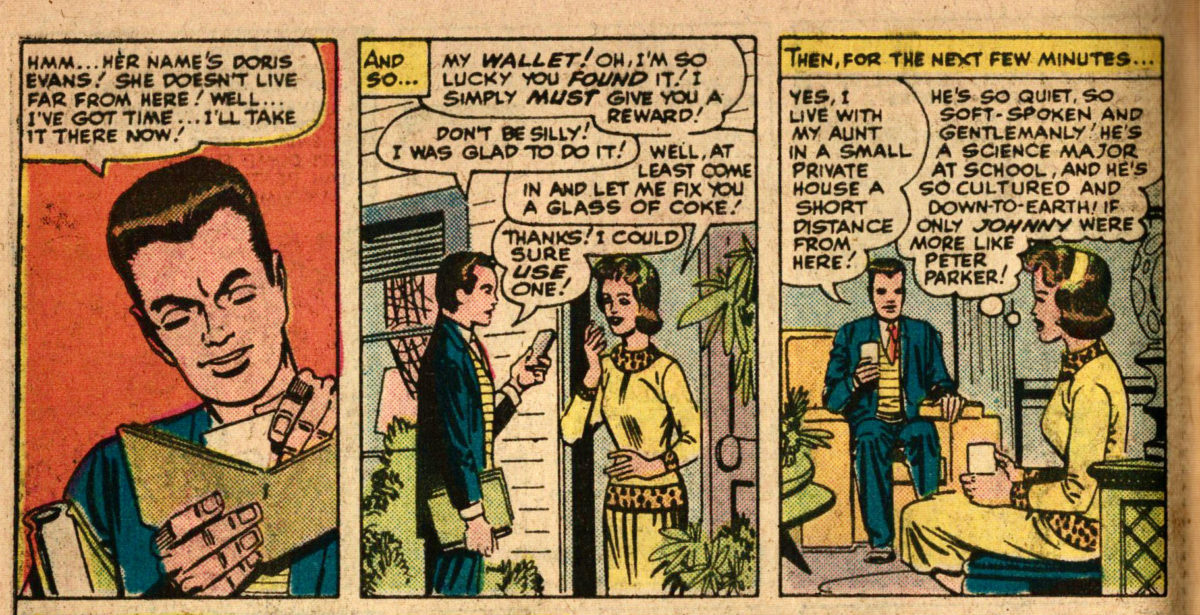
That brings us to the featurette which is the main subject of this post: “The Secrets of Spider-Man!” This isn’t a narrative story, but it is told in standard comic panel format. We get a recap of the origin of Spider-Man followed by a detailed analysis of his powers and web shooters.